
When one of my dad’s oldest friends sent me his own father’s aviation story I quickly realised that it was one of the most fascinating tales I had read for some time and, amazingly, had never before been published. Knowing it had to be shared, I asked Peter Barker, for that is who wrote the words you see below, if he would entrust Global Aviation Resource to do just that. I am eternally grateful that he said yes and also provided all the imagery you see here to truly bring it to life.
So, we present to you a great, until today untold, aviation story – that of Noel Barker and his life in the air.
Gareth Stringer – Editor, June 2026
‘Luckier than Most: A life in the Air’
Like many people of his generation, Noel Barker was modest about his achievements as a Royal Air Force pilot in the Second World War and his many years of service for British European Airways (BEA).
However, his logbooks, which cover his nearly 20,000 hours in the air tell a very interesting story.
They bear witness to the war years and cover the technological development from unreliable piston engine aircraft to the first passenger jets, from basic navigation to what we have today, and from hit and miss weather forecasts to, well, much better forecasts!
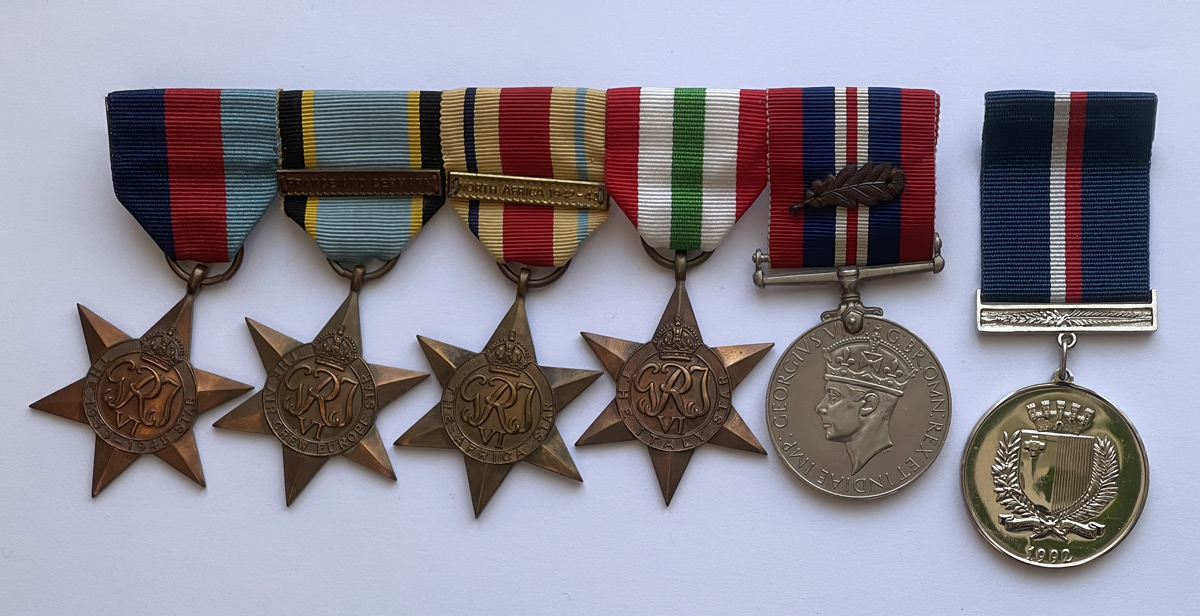
Noel Barker’s medals
Unlucky beginnings
Noel Barker was born in 1921 in Pontesbury, near Shrewsbury. By the age of seventeen, he was fascinated by aircraft, but having failed to pass his Certificate of Education at Stamford School, he was unable to become a pilot. The only way that he could get anywhere near an aircraft was to accept an unpaid apprenticeship with International Air Freight Ltd. (IFS) at Croydon Airport in May 1938. At that time, Croydon was the main airport serving London.
However, bad luck would befall him when he lost his job at IFS after only eight months, due to the growing tensions in Europe. IFS’ reference letter states that “He very quickly showed himself to be an intelligent young man, who took a great interest in his work. His time keeping was excellent but due to the withdrawal of the company’s services at the time of the political crisis (the Munich Crisis), we are obliged to terminate Mr. Barker’s employment”.
Following this, Barker applied for a job at KLM (Royal Dutch Airlines), where he became an import clerk at Croydon Airport. For the first month, he worked for free with only the promise that he would earn ten shillings (50 new pence) a week if he was good enough. After the outbreak of the war in September 1939, Croydon would become an RAF base, forcing KLM to move its operations to Shoreham Airport. (At that time, KLM painted their planes orange to denote that The Netherlands was a neutral country). Barker didn’t work there for long either, as in May 1940 Germany invaded The Netherlands, where KLM was based, leaving him without a job again.
In the summer, he managed to find further employment at Croydon Airport as a timekeeper for Redwing Aircraft, a company that produced two-seat, single-engine, biplanes. It was hard work with shifts of 12 hours on / 12 hours off, seven days per week. On the 15th August, Barker looked out of the front room of his home to see Croydon Airport being bombed by the German Luftwaffe; a daring daylight raid, which left Redwing completely bombed out. At that precise time, his own father was working at the airport and suffered permanent health problems associated with smoke inhalation.
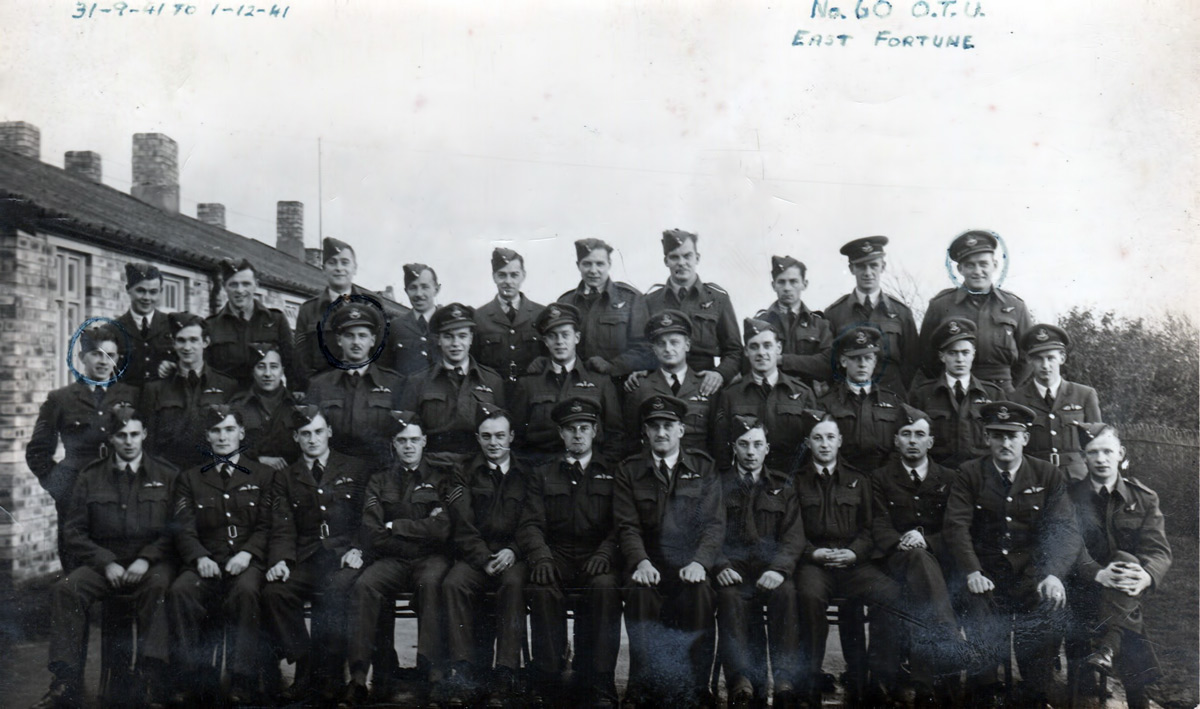
No.60 OTU – East Fortune 1941 – Noel is 2nd from the right in the middle row
So, by October 1940, Barker had found and lost three jobs. Bad luck and world events had repeatedly prevented him from getting a career in aviation. However, finally, everything changed when he was finally able to sign up with the RAF as aircrew. After first learning to man a machine gun, he began his flight training and in May 1941, he flew solo for the first time in a Tiger Moth. His training included formation flying in the Hurricane MK1 (serial number P2617), which is now exhibited at the RAF Museum in Hendon. By October he had flown solo for 140 hours and as a result of his “above average” night vision test, he was chosen to become a night fighter.
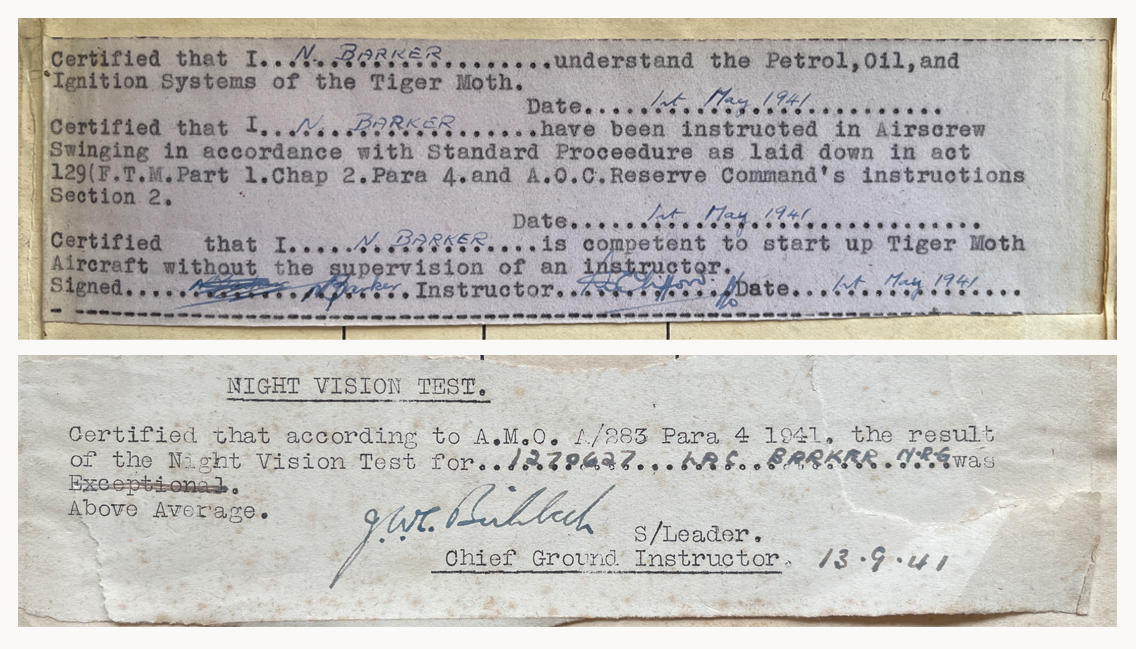
153 Squadron
In December 1941, Flying Officer Barker’s first tour started with 153 Squadron night fighters in Northern Ireland. The squadron was still flying the unreliable single-engine Defiant 1, which had a four-gun turret and a crew of two. The squadron later converted to the use of twin-engine Beaufighters, which was a big leap forward.
The squadron’s main task was to protect Belfast and its shipyards at night or in difficult weather. They would also pick up friendly Atlantic Convoys just off the Irish coast and, later in the “Beaus”, they would be able to meet them much farther out.
A good friend, F/O Jack Haddon, described these early days in his memoires; “Our start-up was less than auspicious. There was little or no enemy activity, dreadful weather, difficult airfields, ropey aircraft (Defiant) and rambunctious young crews, all of these led to unacceptably heavy casualties”. (Over the following years, Haddon was promoted to Squadron Leader. He also was awarded the Distinguished Flying Cross (D.F.C.) having achieved five victories. In fact, he maintained that he had only shot down four enemy aircraft!)
The situation changed in December 1942 when a detachment from 153 Squadron flew in their Beaus to Maison Blanche, Algeria (now the main airport of Algiers). The initial crews flew to Portreath in Cornwall and then on to Gibraltar, before progressing to Algeria. F/O Haddon remembered the trip as follows; “As no aircraft had any navigation aids other than the normal flying instruments, not so much as drift sight, we were anxious not to miss Spain altogether. In fact, we took off straight into the worst sort of weather and flew the entire length of a winter Atlantic cold front with cumulus nimbus cloud, extreme turbulence, hail, ice, lightning and St. Elmo’s fire. Twelve of the thirteen crews arrived shaken, but on time. The one crew that had to turn back, arrived the next day”.
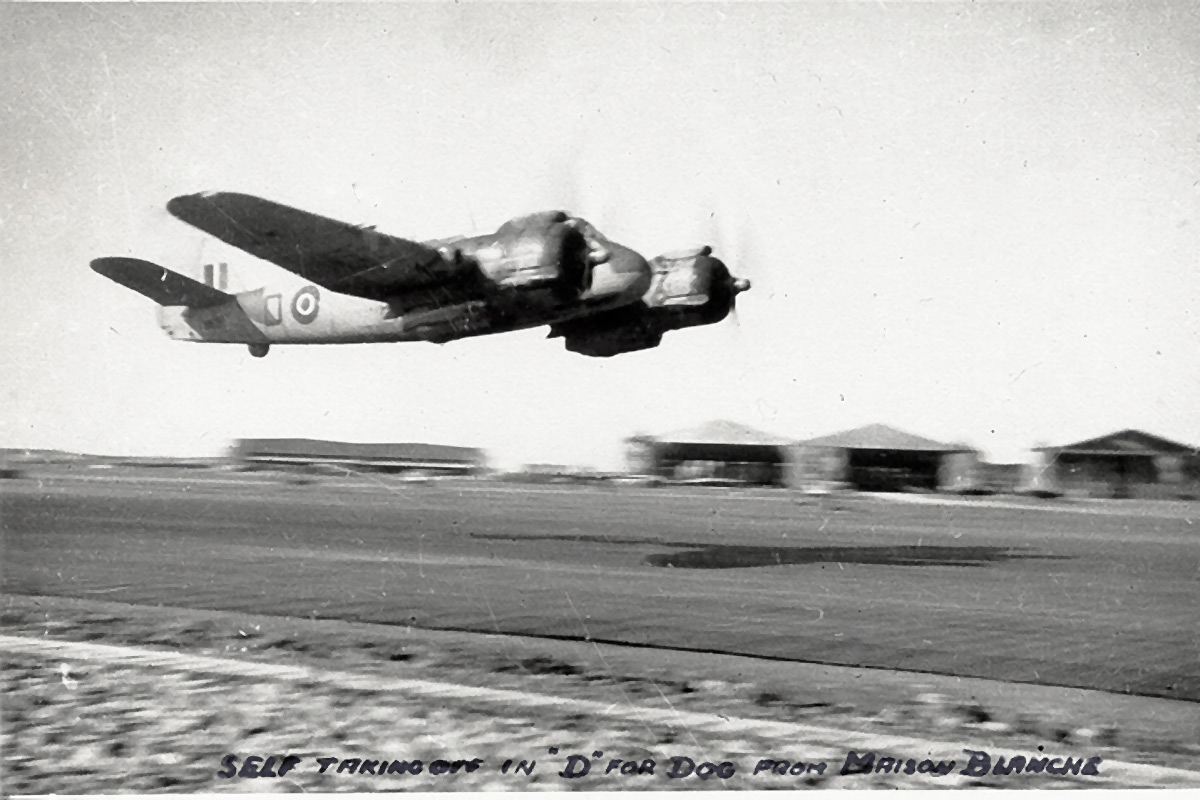
Noel taking off in Algeria
This deployment was two months after the Battle of El Alamein in Egypt, which turned the tide of the war in Africa. 153 Squadron was tasked with the defence of the Allied convoys at night, which travelled eastwards along the African coast in anticipation of the invasion of Sicily. Along the route, Axis aircraft, based in Sardinia and mainland Italy, would attempt to attack these convoys.
“On 24th December, F/O Rayment and P/O Lanning had flown a V.I.P. to Malta and had been briefed to keep him well away from the heavily defended Tunis area. No one had said anything about the return journey, so on Christmas Eve, in broad daylight they dropped into Tunis Bay using cloud cover, shot down a Ju88 and damaged a floatplane. They then came back to base in high glee and recorded 153’s first ever combat victory”. Later, F/O Rayment was promoted and awarded the DFC. According to Wikipedia, “He had shot down five German fighters, one Italian plane, and a V-1 flying bomb”.
After that initial success, things were quiet, too quiet, if you don’t count the incidents of “friendly fire”. In fact, the monthly squadron report of 14th July 1943 quoted F/O Barker and Sergeant Sherbrooke summing up the situation after a two-and-a-half-hour flight in their Beaufighter VI, as follows; “I have just returned from a patrol with Hoarding and, as usual, things went just according to the normal tradition, which Chevron 28 has grown quite accustomed to of late. There wasn’t a Hun to chase or shoot down. There wasn’t any flak to watch over the town nor even a bogey to chase and pretend, honestly chaps……….this is the end”.
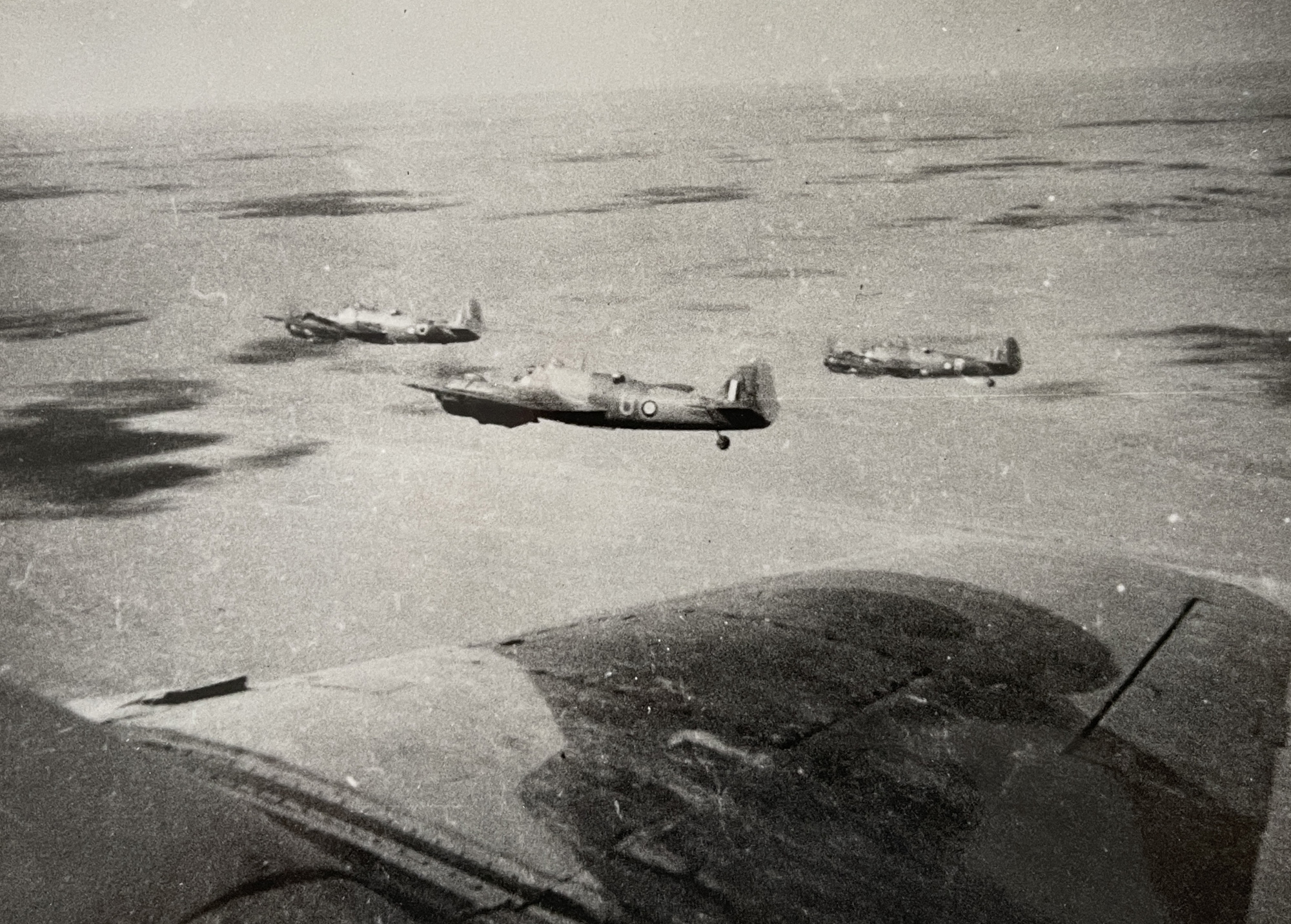
Four Beaufighters over North Africa in 1943
This doesn’t mean that times were dull. Passengers were sometimes crammed into their small plane to be taken to another airfield. For instance, the pair ferried Air Chief Marshal Tedder to Chateaudun, Algeria, and F/O Barker himself noted that he had returned from Setif as a passenger along with “F/O Jowling and two live turkeys”! Being the 10th January, it was probably a bit late for Christmas!
On another occasion, he was taking a passenger to Luqa, Malta, when his brakes failed and the plane ended up in a bomb crater. Later recalling the incident, F/O Barker smiled and said “they were not very happy with me”. To get back to base, he hitched a ride in a Dakota, but it got lost in a sand storm and they ended up in Misurata, Libya.
F/O Barker and Sgt. Sherbrooke flew at least 318 times together, mainly over the North African coast. They took part in many patrols, sweeps, and scrambles, although often “bogies” (unidentified aircrafts) turned out to be friendly and “bandits” (identified enemy aircraft) didn’t materialise.
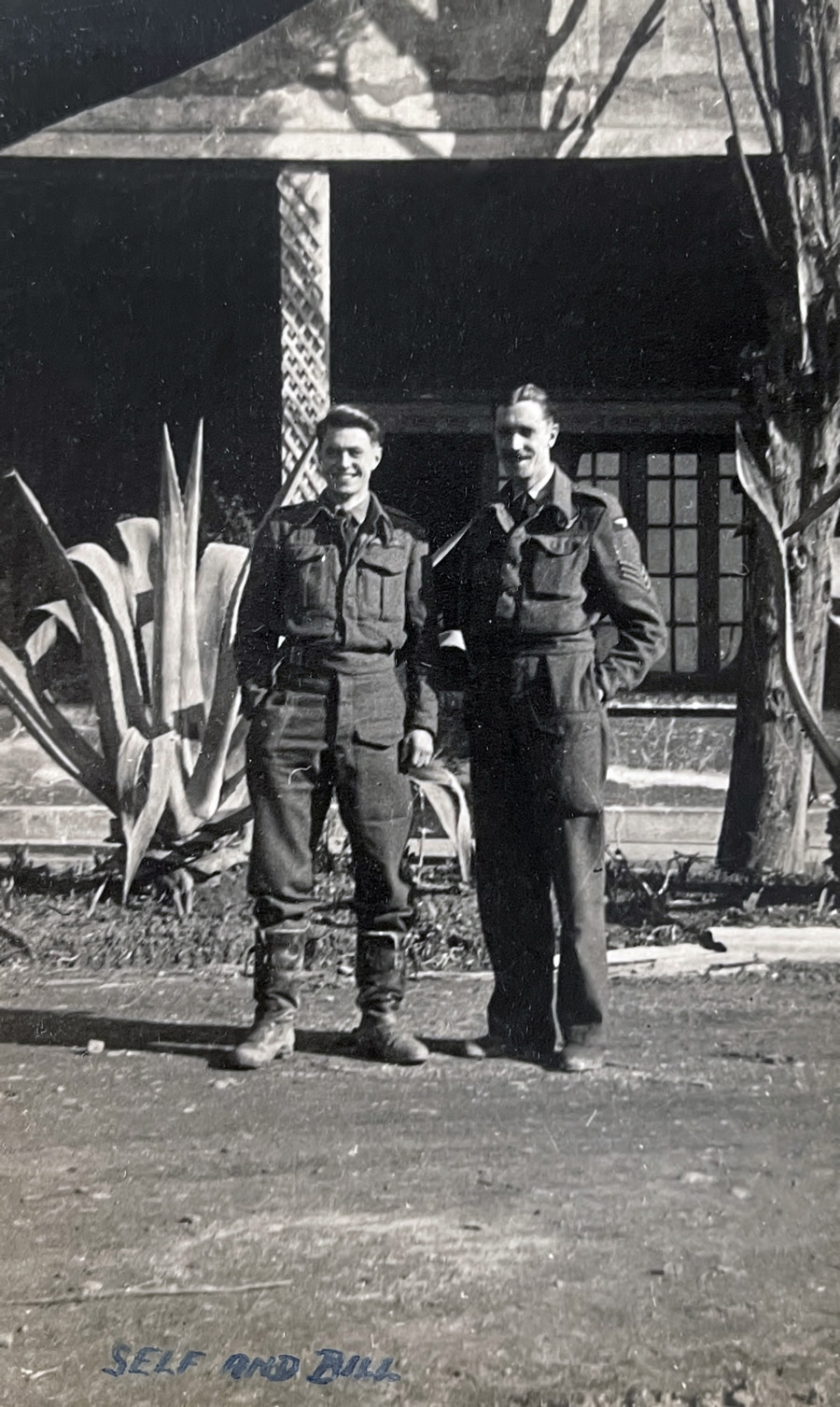
Noel Barker and Sgt Bill Sherbrooke
As Jack Haddon put it in his memoirs; “Some would be up night after night and see nothing; others would run into trade on a night test flight. Noel and Bill flew more than their share of missions; the bandit was always gone off the screen before they got there. Then, in the middle of a lot of enemy activity, they got on to the tail of a bandit, chased it and their AI set (airborne interception radar) blew up.
Noel was his usual imperturbable self; Bill was as near to tears as a north country man could get”.
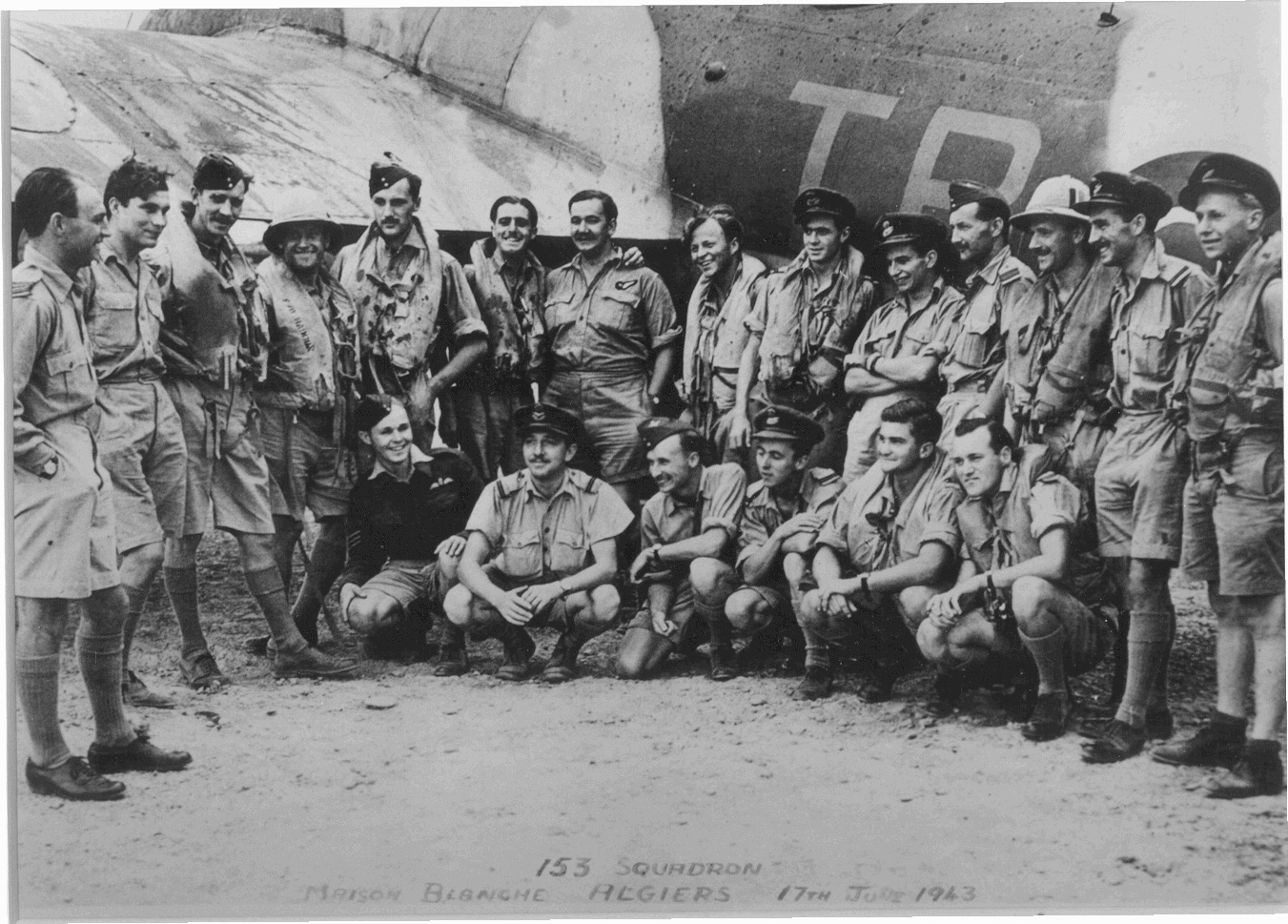
153 Squadron in Algiers – 17th June1943: Noel is standing under the “T” of the serial. Bill Sherbrooke is 3rd and Jack Haddon 4th from the left. Ken Rayment, standing, and Len Smith, sitting, are the farthest on the right.
Within a month of the British Army landing in Italy at the beginning of September 1943, the squadron’s score had already reached 50. Most of the original contingent of 153 Squadron, including F/O Barker, were put on a ship back to the UK. A month later, the same ship, the Marnix van St. Aldegronde, was hit by a torpedo in the Mediterranean and sank whilst being towed to port.
At the end of this campaign, F/O Barker was promoted to Flight Lieutenant. He had 823 flying hours under his belt, including 213 operational hours and 91 operational sorties. The funny thing was that when applying for the Africa Star, he and his 153 Squadron veterans were initially refused it, because according to official records, they had remained in Northern Ireland the whole time!
In comparison with the Defiants, the Beaufighters had performed very well, but Barker’s logbooks reported the following incidents: Aircraft unserviceable (U/S), port engine failed, Engine trouble (x4), crash caused on landing by U/S brakes, plus the following U/S for various reasons: weapons, instruments, intercom and AI set.
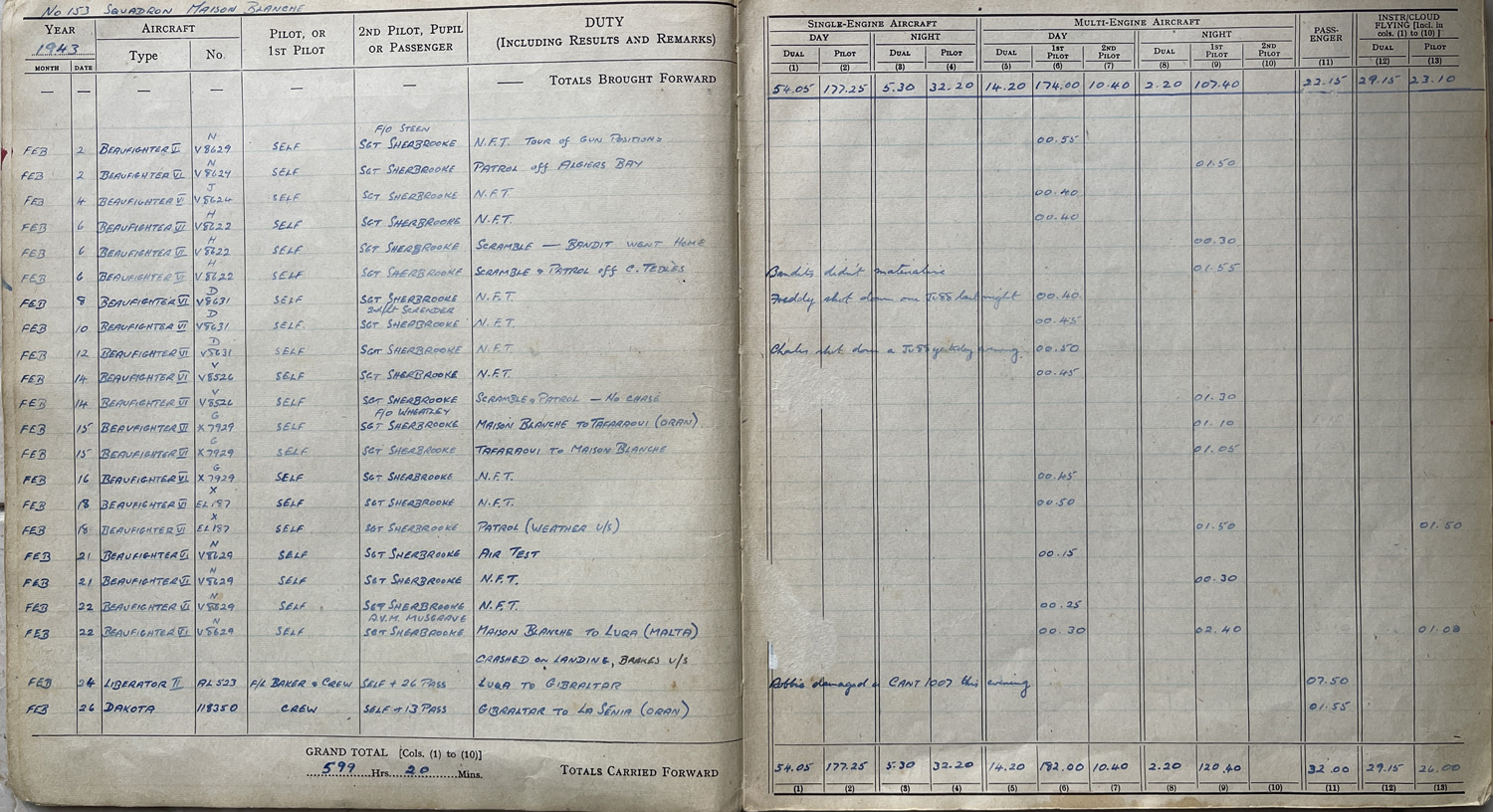
Logbook scan from 1943
Despite everything, he had made it back to the UK, but not all of the 153 Squadron were as lucky. Jack Haddon expressed the survivors’ huge sadness of losing these valued friends, “They had left fifteen comrades to lie forever beneath the blue waters of the Med”. In addition, Sgt. Sherbrooke stayed on to wait for his commission to come through, but was tragically killed on 26th November 1943. “When last heard of, they (W/Cdr Stephenson and Sgt. Sherbrooke) had gone over to intercom and were in contact with a Hun 80-90 miles north of Bougie”.
The following day, despite bad weather, seven aircraft were engaged in the search with no success. “Sherbrooke will long be remembered for his dry sense of humour and good nature”.
264 Squadron
After some rest and recuperation, F/L Barker attended a training course to be certified as a Flying Instructor. Then, on 31st March 1944, he was transferred to 264 Squadron, another night fighter operation, based in Yorkshire. The squadron was already using the timber constructed, twin-engine, Mosquito (XIII & XVII), which were even more competitive than the Beaufighter. His log books proved that they were also much more reliable than the Beaus, except for the airborne intercept set which failed four times over this period.
Initially, 264 Squadron was patrolling off the Humber Estuary and over the Channel, but two months later, F/L Barker and his navigator, F/L Smith, were flying a night beachhead patrol over the south of Caen, France. This was on 6th June, D-Day, one of the most important days of the war. For more than a month, they continued a variety of patrols over France, chasing several bogies with no satisfactory results, but instead being hit by friendly fire; “Shot at by Yanks, unfortunately close, hit twice by flak”.
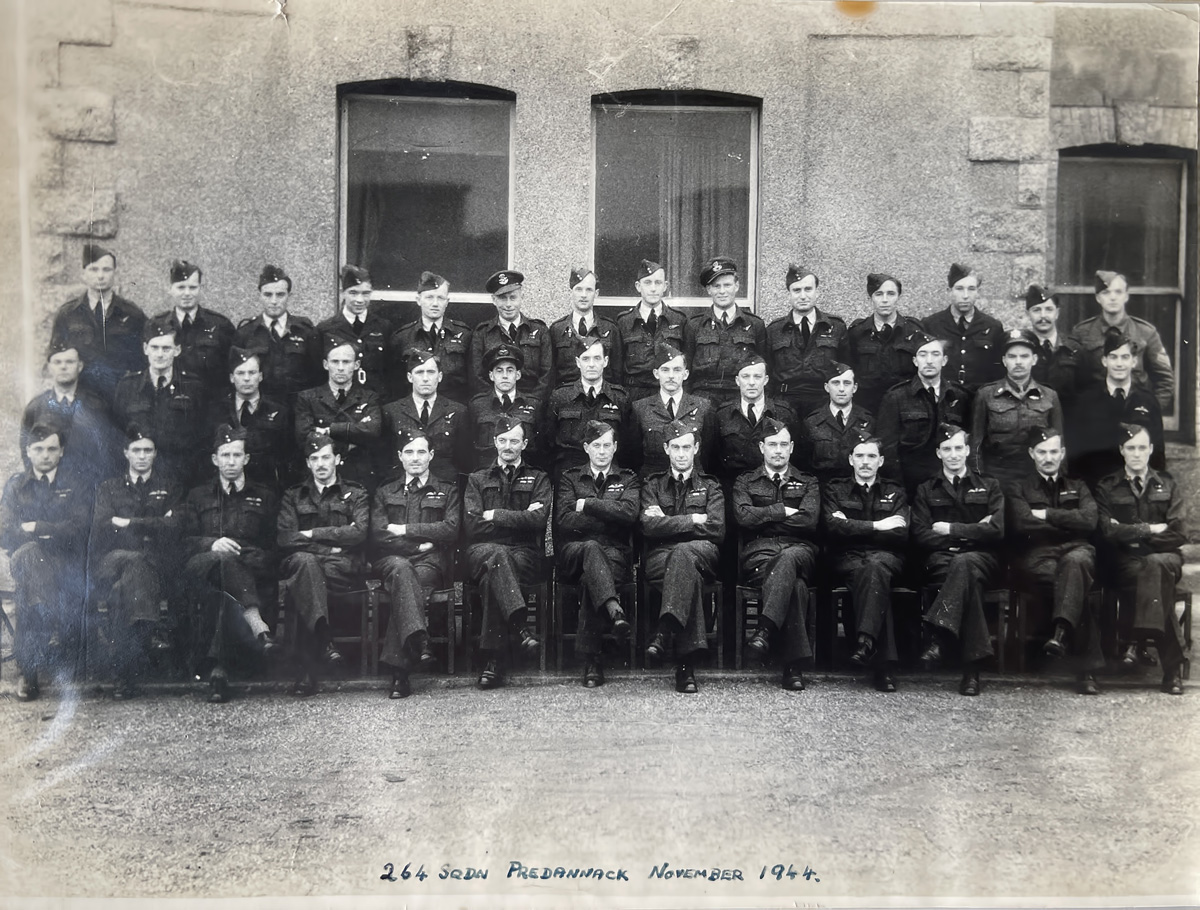
264 Squadron -Predannack 1944
In mid-July, F/L Barker and F/L Smith commenced “Doodlebug patrols”, which meant trying to shoot down the V-1 flying bombs launched from the French and Dutch coasts. In total, they shot at four: “two chases, damaged one!” and “two chases, bags of shooting, no effect”.
After being relocated to Normandy in August 1944, back to the UK in September, and then to Lille in January 1945, they continued patrols over France, Belgium and, eventually Germany, following the Allies’ advances across the continent. During this time, they watched the launch of four V2 rockets while flying over the Scheldt estuary, between Belgium and The Netherlands.
Then, at the beginning of March 1945, their starboard engine failed over Cologne, forcing a return journey and a crash landing; “Tipped up at the end of the runway, damaged one propeller blade”. This was to be one of the last flights of the Barker/Smith crew, who had accumulated a total of 186 flights together. Not because of the uncomfortable landing, but because F/L Barker had been chosen for another mission, unlike any of his previous experiences.
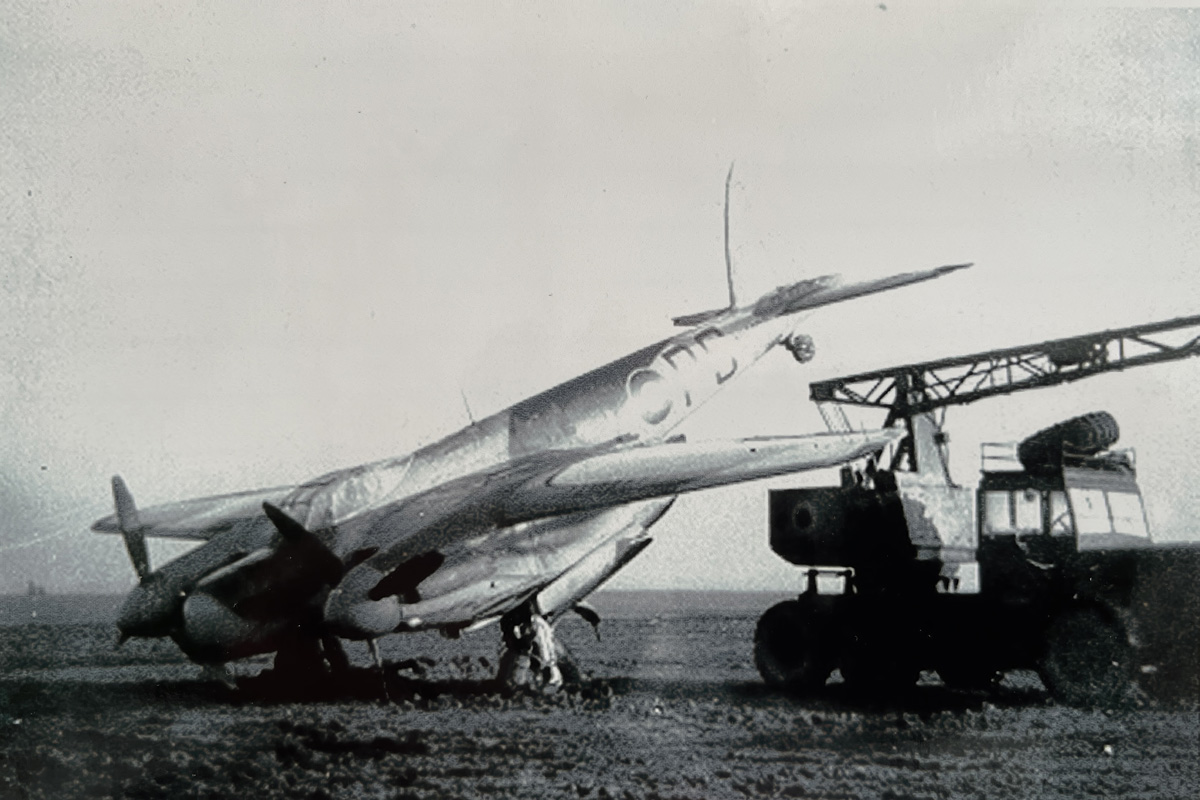
Accident – 1945
Based in Gilze-Rijen, The Netherlands, F/L Barker’s final month of the war would be spent taking part in Operation Blackmail.
His job was to enable Dutch secret agents to communicate with the resistance in the occupied areas of the Netherlands. These very short missions, which required flying higher than normal, at 20-25,000 feet (6,000-7,500m), and at speeds of up to 300 knots (555KPH), which was as fast as possible. To achieve this, there was no navigator and no excess weight, not even ammunition. The Dutch intelligence officer would sit in the navigator’s seat while using a portable S-Phone radio set to communicate with the ground.
The pilot’s point of view was explained by good friend and fellow pilot, F/L Jonny Bentley in Max Arthur’s 1993 book ‘Lost Voices of the Royal Air Force’. “Only me and the Dutch officer were sitting in the cockpit of the Mosquito. We sat next to each other. The officers had their own radio stuff and we had our normal VHF. They were speaking to the resistance on the ground, but we hardly ever discussed it between ourselves. We would just come back to the operation room in Tilburg and report, and then Tactical Airforce headquarters assessed the information gathered at local level and deployed aircraft to bomb the target”.
Jonny Bentley continued, “The information gathered was so good and so specific that on several occasions Typhoons were able to carry out attacks accurately right down to the house. In many cases orders were issued immediately to prepare for an air raid. I can still remember listening to the BBC at 9pm and hearing the news that Typhoons had attacked a certain area where we had been flying around that morning. That gave me a very satisfied feeling”.

Op Blackmail 1945
F/L Barker made his last RAF flight on 27th March 1945. In total, he had flown 371 operational hours including 150 operational sorties. During that time, he had personally seen the progress of the war, starting on the back foot with convoy patrols over the Atlantic in 1941, then being transferred to Algeria to protect the shipping in the Mediterranean in the build up to the invasion of Italy. After that, he flew mostly front-line patrols starting over Normandy on D-Day and following the German retreat back to Germany.
Although there were several encounters with the enemy, he had not managed to shoot down one enemy aircraft, but had also not perished, even by friendly fire, which was a small miracle in itself, particularly, bearing in mind the low life expectancy of a night fighter pilot. He had been unluckier than some, but a lot luckier than others.
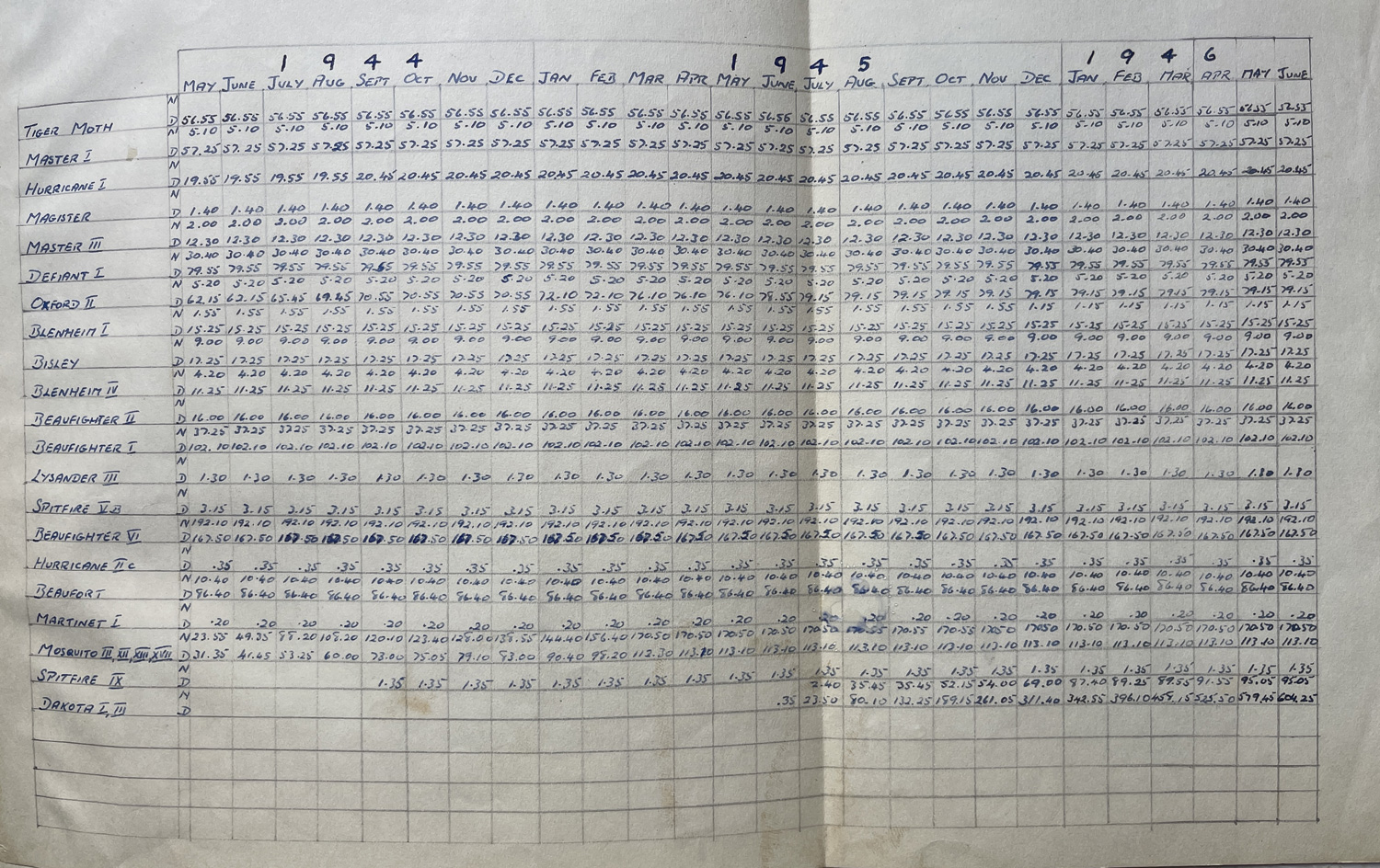
Noel’s record of service by type – incredible
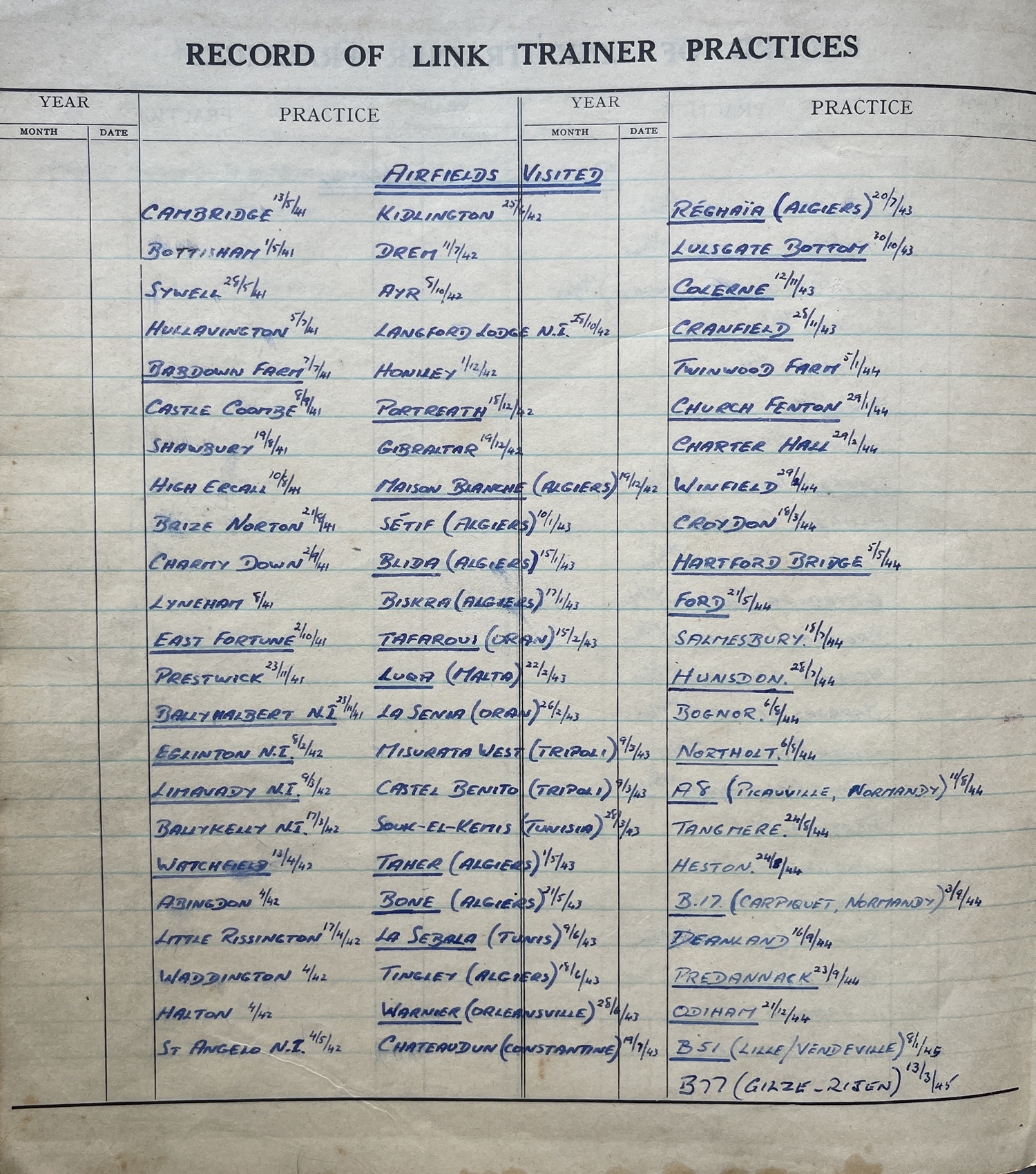
Airfields visited during RAF service
BOAC & BEA
In April 1945, the country was still at war, but F/L Barker had the good fortune to be seconded to British Overseas Airways Corporation (BOAC) at Whitchurch, Shropshire. The war had actually allowed him to fulfil his school boy dream to become a career pilot: something that had seemed impossible in 1938. To emphasise the point, he had the pleasure of flying into Croydon Airport in July 1945 and, no doubt, meeting his old friends.
At the age of twenty-four, his civil career commenced as a co-pilot flying Dakotas (DC1,2,3). At that time, there were very few real airports. Instead, there were aerodromes dotted all over the place and long-distance flights still entailed many stops. As an example, a trip to Cairo in August 1945, went like this: Whitchurch / Hurn / Marseilles / Malta / El Adem / Cairo. The out and return trip used four planes over the six-day period. One surprise was when the Aga Khan and his wife were on board for the Cairo-Malta section!
An assignment, which didn’t seem so important at the time, proved to be memorable. On 1st January, 1946, F/L Barker was rostered to be the co-pilot of a Dakota, which flew to the new London Airport (Heathrow, then referred to as LAP) on its first day for passenger traffic. Together with Captain Wallace, they flew a group of press journalists around so that they could view the new airport from the air. Of course, the runway was there, but no passenger buildings had been constructed, just ex-military marquees. There were only two planes that flew that day. One was the first ever passenger aircraft to take-off from Heathrow, the British South American Airways Avro Lancaster, which wound its way to Buenos Aires. The other was the Dakota G-AGKG, which landed, did a fly-around for half an hour, landed once again before returning to Whitchurch. Just imagine how many million flight movements there have been at Heathrow since then!
On that same day, British European Airways (BEA) was established, initially based at Northolt. A month later, F/L Barker was transferred to the new company. Once his demobilisation became effective on 20th June, he officially became a BEA Junior Captain, receiving a salary somewhere between £600 and £700 per annum.
Noel Barker BEA 1950’s
In these early years, weather had an even greater effect on passenger flights. One February, flying between Stockholm and Goteborg, his pilot’s log book states; “landed by mistake in Save (a nearby airport) due to poor visibility”. If that happened now, there would be an enquiry!
“Bad weather, wind, fog” were all cited causes for “delays, overflying, diverted, and need to return to base”. It seems amazing now to think that his plane could take off from Northolt, fly to Paris, only to find that the weather there was so bad that it had to return to Northolt. That meant over three hours in the air.
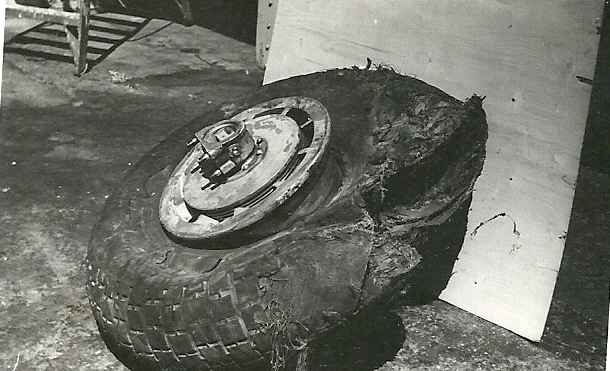
Burst tyre! (1948)
It is difficult to imagine now what it was like in the 1940s and even the early 50s. Not just the weather, but also the reliability of the equipment presented great challenges to the air crew and ground staff. It was not uncommon to have minor technical faults or even sometimes “returned due to technical problems”. There were also more serious instances, like: “smoke or fire warning light, single engine landing (Viking), return on three engines (Viscount), trouble with hydraulics, tyre burst on landing, crashed on landing aircraft) written off”. Luckily, the last incident happened during a test flight.
However, there were also great technological advancements in this period. For instance, on 14th January 1954, an unofficial airline route record was announced by BEA. “A Viscount turbo-prop machine covered the 319 miles between Belfast and London Airport in fifty-seven minutes, averaging 333 miles per hour. It was piloted by Captain N. Barker and had 36 passengers on board. Four days ago, a Viscount piloted by Captain A. J. Holderness flew from London to Palma (841 miles) in 2 hours thirty-seven minutes averaging 321 miles per hour.
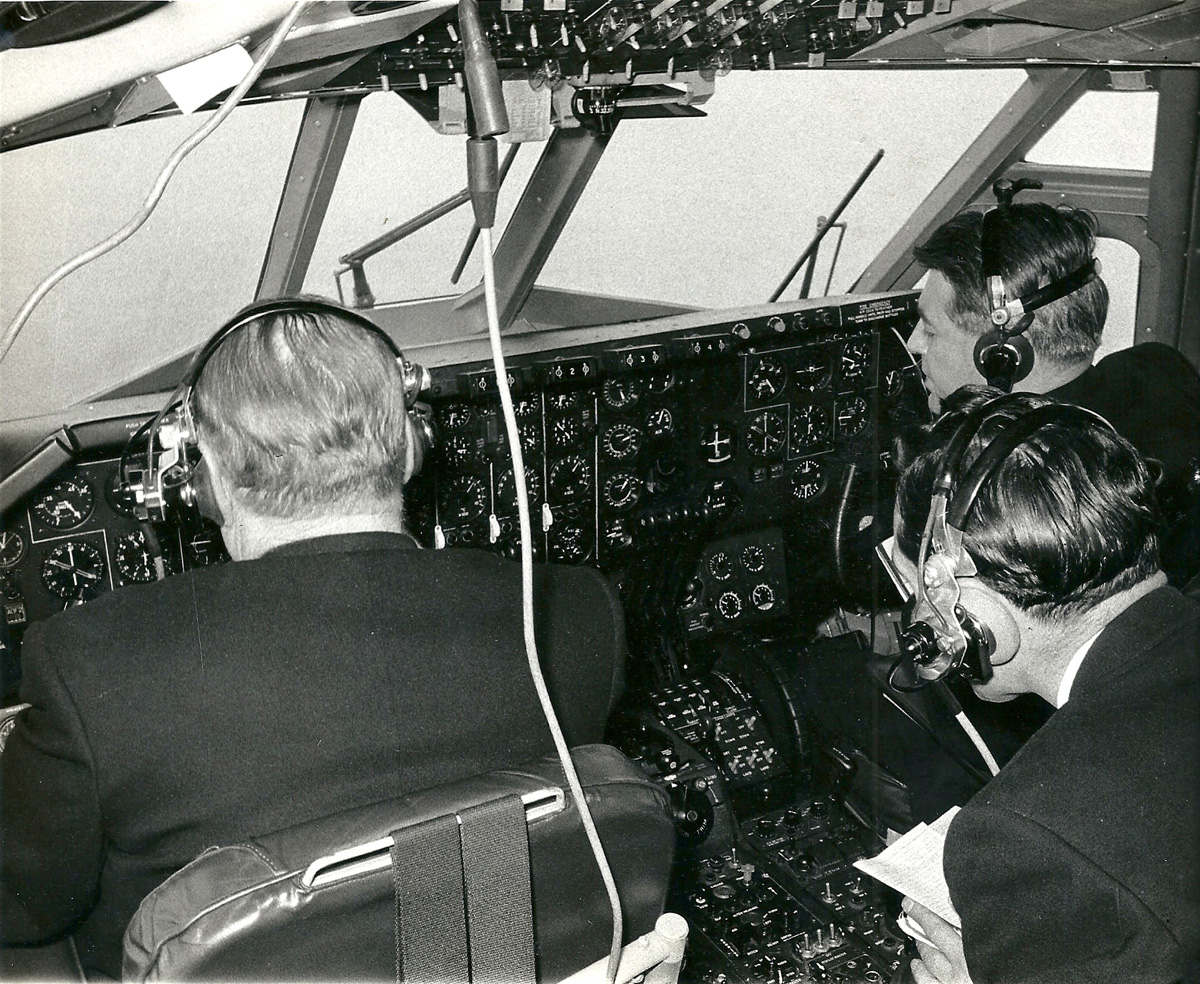
Noel Barker – possibly in an early Vanguard
In fact, Captain Holderness had a similar background to Captain Barker. He had also been a night fighter pilot; first flying with 248 Blenheim Fighter Squadron and then 239 Squadron of Bomber Command. Uniquely, he was one of three brothers, who were born, brought up and learnt to fly in Rhodesia (Zimbabwe), who became pilots in different RAF squadrons and all survived the War.
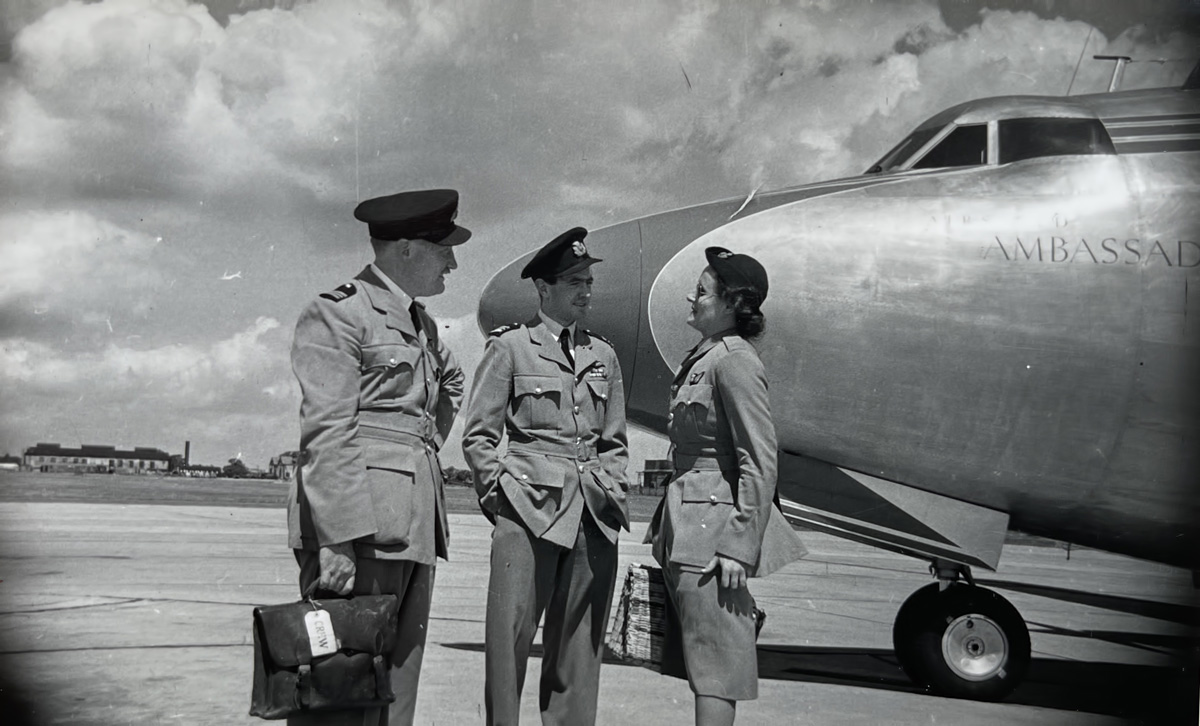
Another especially memorable flight took place on 17th June 1956, when Captain Barker had the honour of being the co-pilot on a Royal Flight from Stockholm to London. Captain W. Baillie and he flew Queen Elizabeth II and members of the Royal Family in a Viscount back from a State visit of Sweden. The group included; Princess Margaret, the Duke and Duchess of Gloucester and the Duke and Duchess of Beaufort. The crew were briefed on many aspects of the flight and their behaviour, but they probably had no idea of the months of preparations and actions that went into such a meticulously planned event.
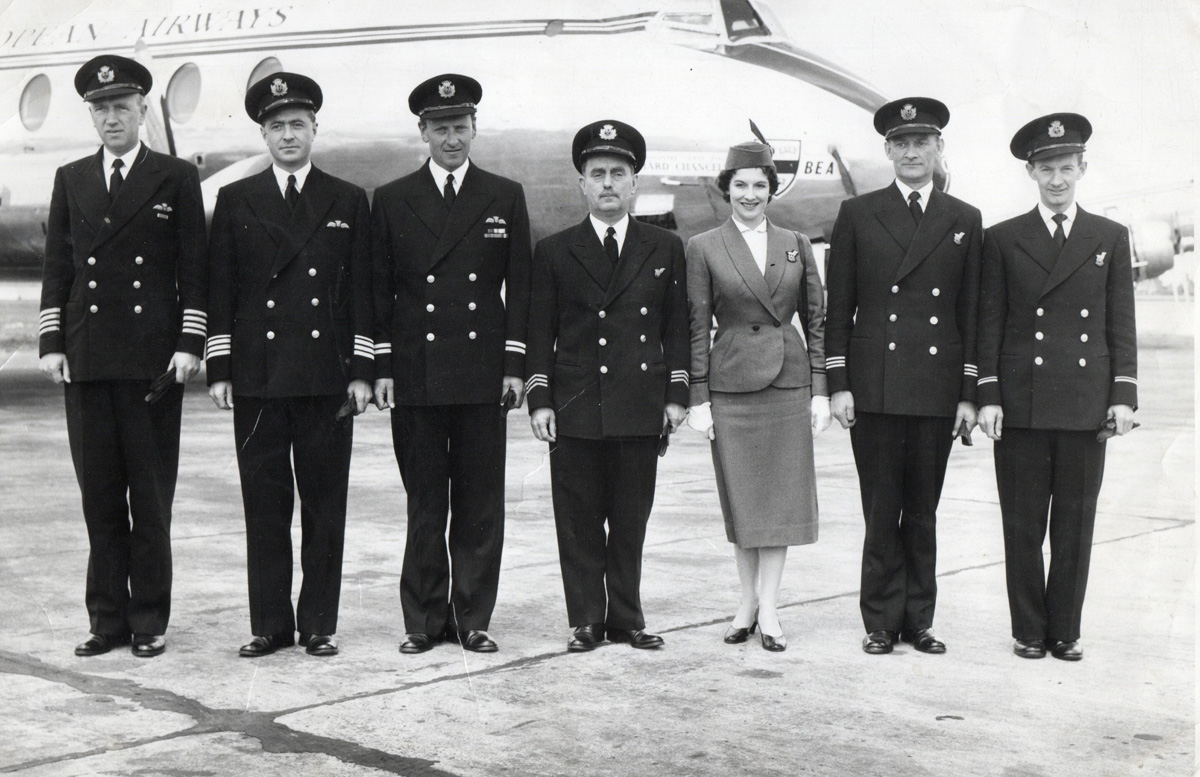
Noel Barker (2nd left) ahead of a Royal flight
Captain Barker recalled a special instruction that he had received, which was as follows; In the event of an incident at sea, Captain Bailie would be responsible for the plane and he, Captain Barker, would be responsible for the Queen. Apparently, there was a life raft on board specifically for the Queen and himself and nobody else. He had been responsible for many things in his life, but this concerned him, as he had no such expertise. Luckily, his (lack of) knowledge of how to treat the Queen in a life raft was not needed.
This would not be his only Royal flight, as in 1957, Captain Barker once again would be asked to fly Royals from Rome to Athens and back. The passengers this time included the Duchess of Kent, Princess Alexandra, Prince Michael, Princess Olga and Elizabeth of Yugoslavia and the Duke and Duchess of Aosta. As a result of his service to the Royal Family, he was awarded the Queen’s Commendation for Valuable Service in the Air on 12th June 1958. (He received an emblem for his uniform jacket, a signed photograph of The Queen and her family, and a certificate signed by the then Prime Minister Harold Macmillan). He was also awarded the Freedom of the City of London by The Honourable Company of Air Pilots.
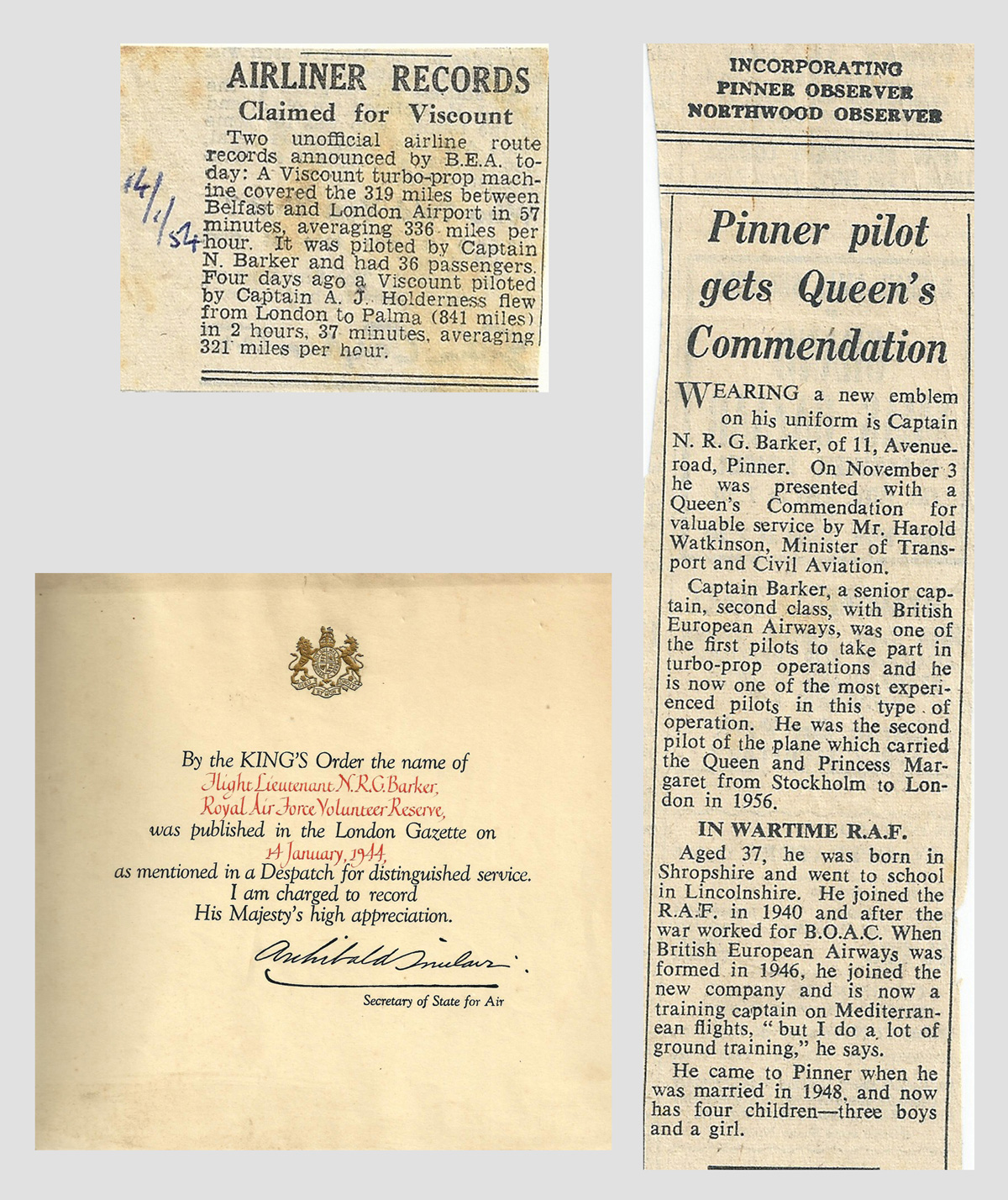
Making the news!
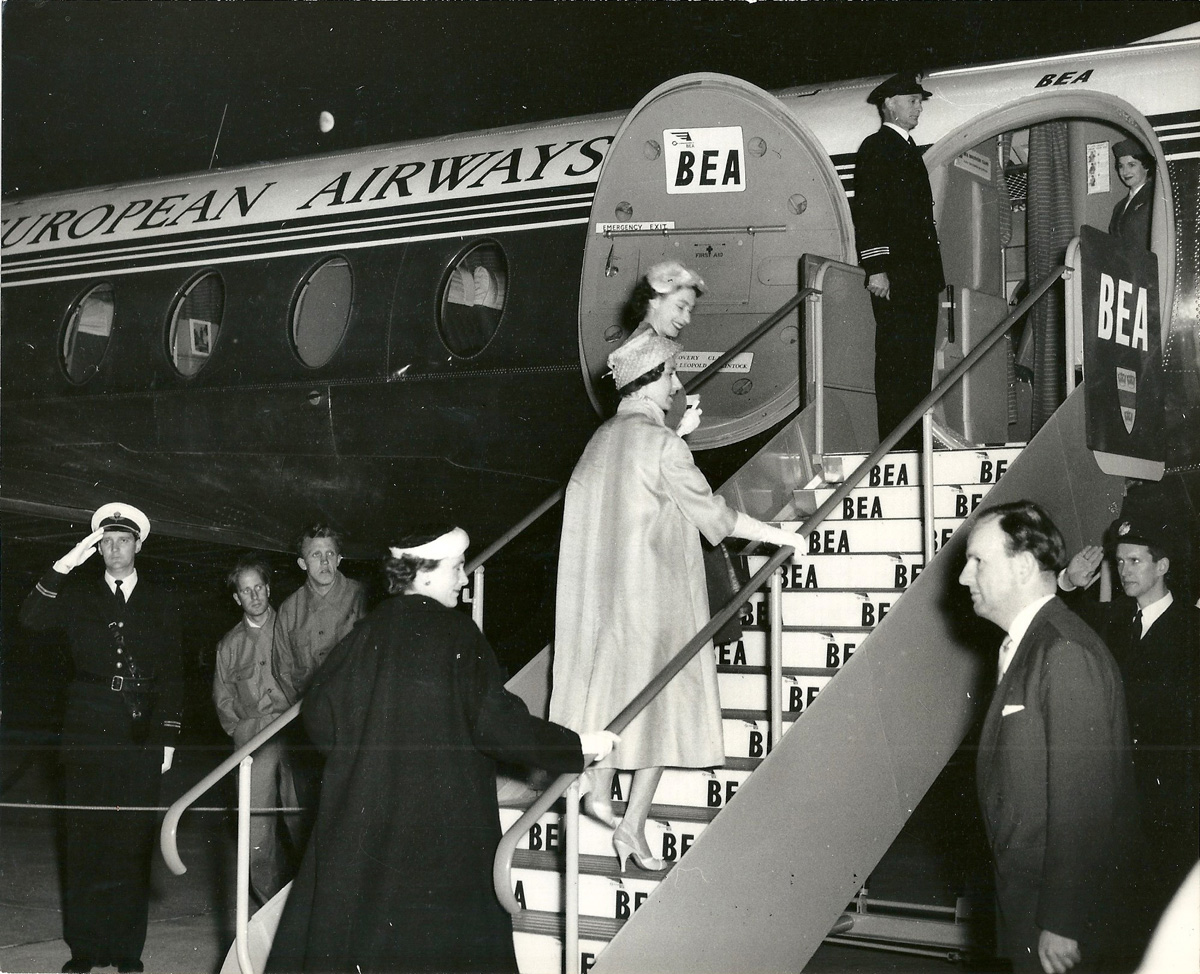
Royal Flight on BEA
Captain Barker was no stranger to flying the press around, as he had also been asked to perform the same duty at Northolt for the introduction of the Viscount in 1953 and there were also some publicity flights in Scandinavia. Now in 1960, he flew a Vanguard with the press to Gibraltar and back. By special permission, he was allowed to take his family on the flight as passengers. They had just one hour twenty minutes turn-around time to enjoyed the peninsular.
Captain Barker, a good-looking man, also came to prominence in 1965, when he was chosen to appear on a BEA poster with a new Trident in the background. This photograph was also used in the “Sun, Fun and BEA” magazine advertisement for BEA Silver Wing Holidays. The offer, an all-inclusive 2-week holiday in Venice cost just under 50 Pounds. Not bad! Sometime later, when looking around a shop, he suddenly came face to face with his own image on a poster advertising a certain luggage manufacturer. He didn’t know anything about this so he wrote to the company in question and they decided to pay him with a free suitcase. Now, he was a real professional model!
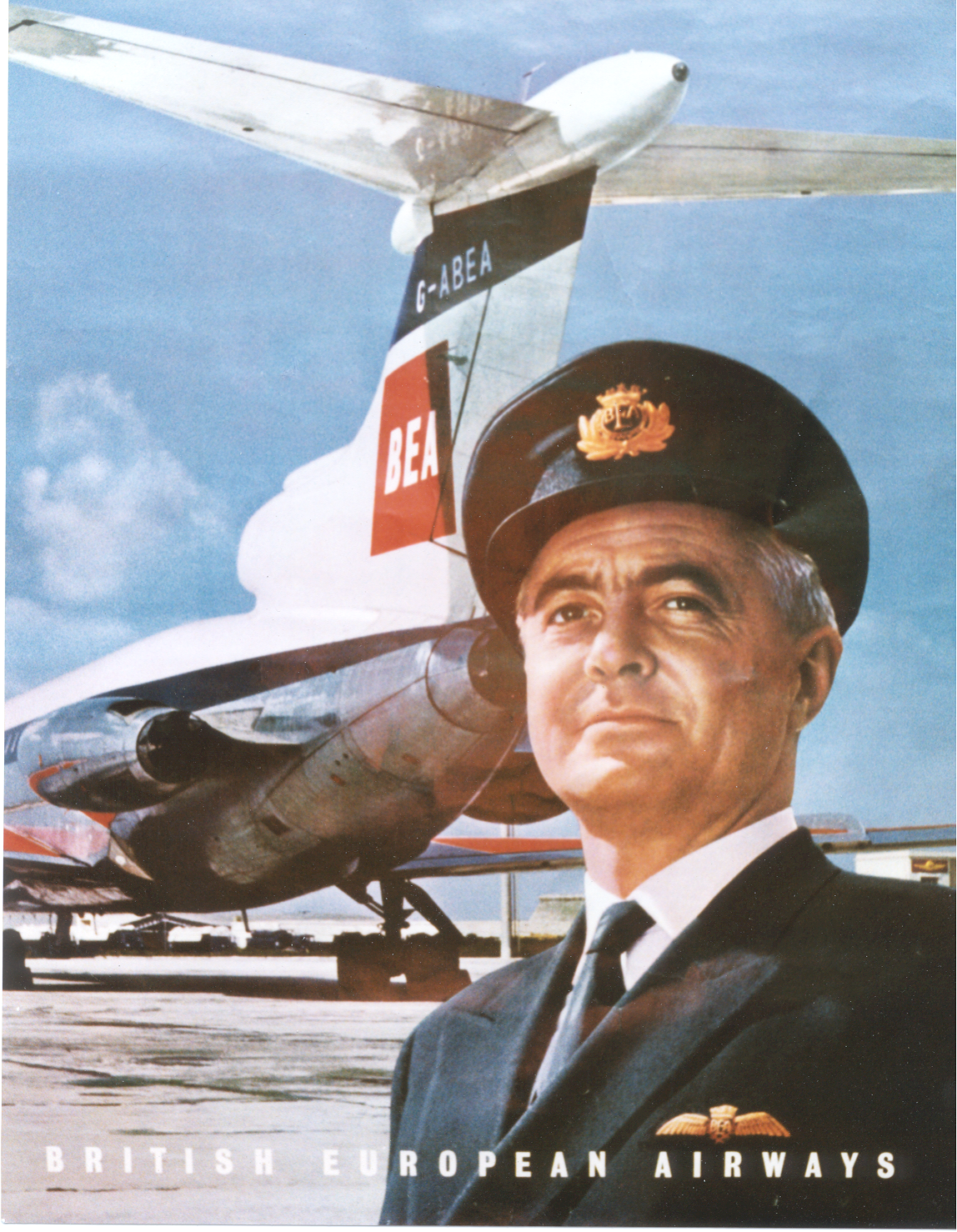
BEA advertising 1965
As an experienced Senior Captain, he was involved in flight trials, like testing the take offs and landings of a BAC 1-11 and a Trident 1E at Tempelhof, Berlin in 1966. He also helped train other pilots in his Route Checking capacity. One pilot mentioned that Captain Barker “could land on a Sixpence”, which apparently was a good thing. He also received compliments from passengers; two letters were found alongside his log books:
Northolt to Athens 1948. “I wish to express my deep appreciation to Captain Barker and to the crew of Viking B-AJBO for what, mostly under very trying weather conditions, can be called a ‘perfect flight’. All landings were brilliant – including a night-landing in absolute darkness at Marseilles. Never had the feeling of absolute security left the passengers with thanks to the contact which Captain Barker maintained with us either personally or through the crew.” Signed C.I.
Heathrow to Edinburgh 1963. “I refer to Capt. Barker’s handling of his aircraft on Flight BE.5410. Although the wind was so strong as to make standing at Turnhouse difficult, he made a perfect landing with apparent ease. His decision to land here at all in the conditions was praiseworthy…..under such circumstances, even a rough landing would have been forgiven, but one of such ease and comfort is rare even in perfect conditions. Captain Barker and his crew deserve a very warm vote of thanks.” Signed CGD.
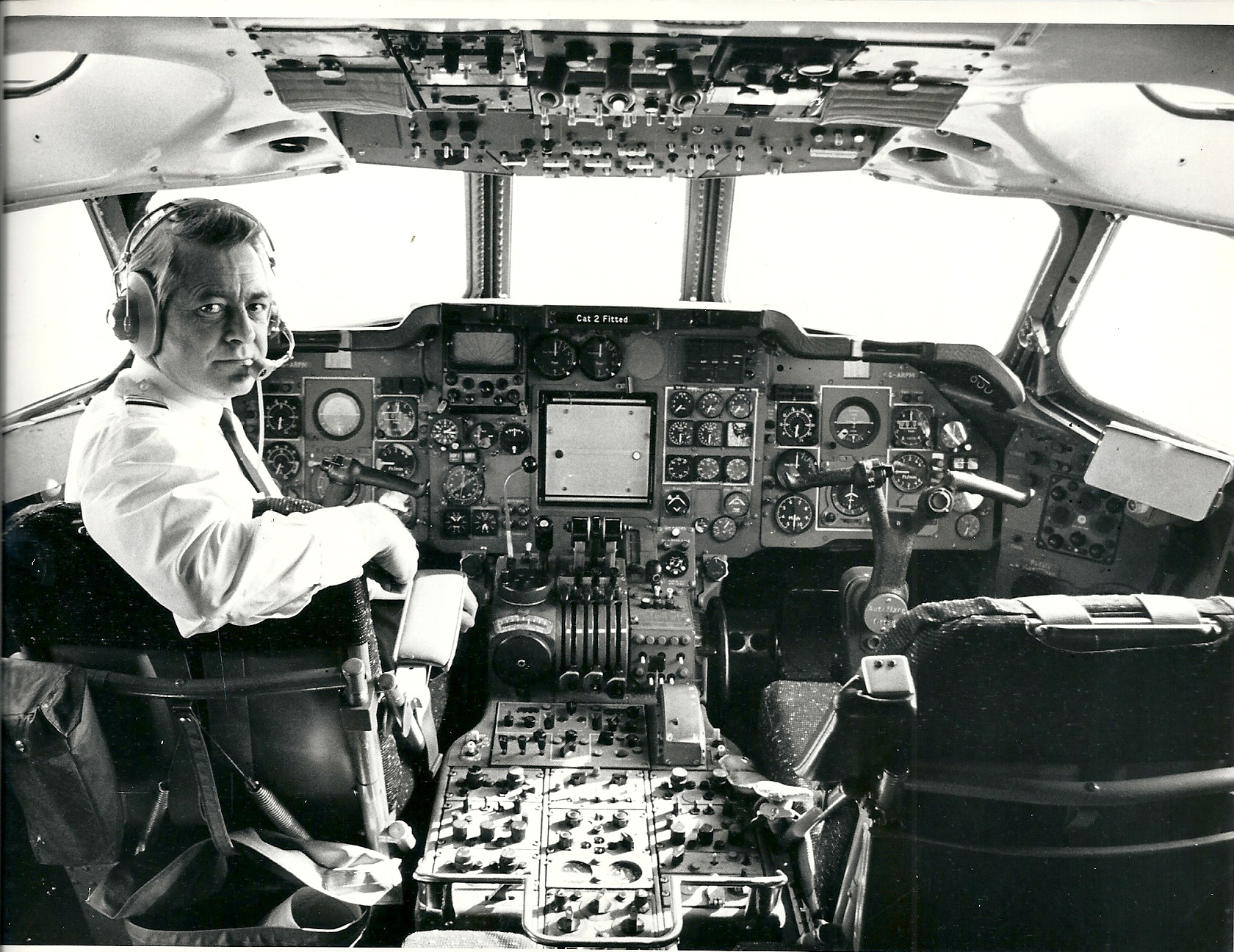
Noel – possibly in Trident cockpit
In 1975, at the age of 54, he flew his last aircraft, a Trident 2, to Glasgow; not the most exotic destination one could have chosen for a farewell!
By that time, he had spent 19,653 hours in the air (2 years, 88 days and 21 hours). This included eight different single engine aircraft and twelve different multi-engine aircraft (not counting all the variants) and visiting a large number of aerodromes (70) and airports (71).
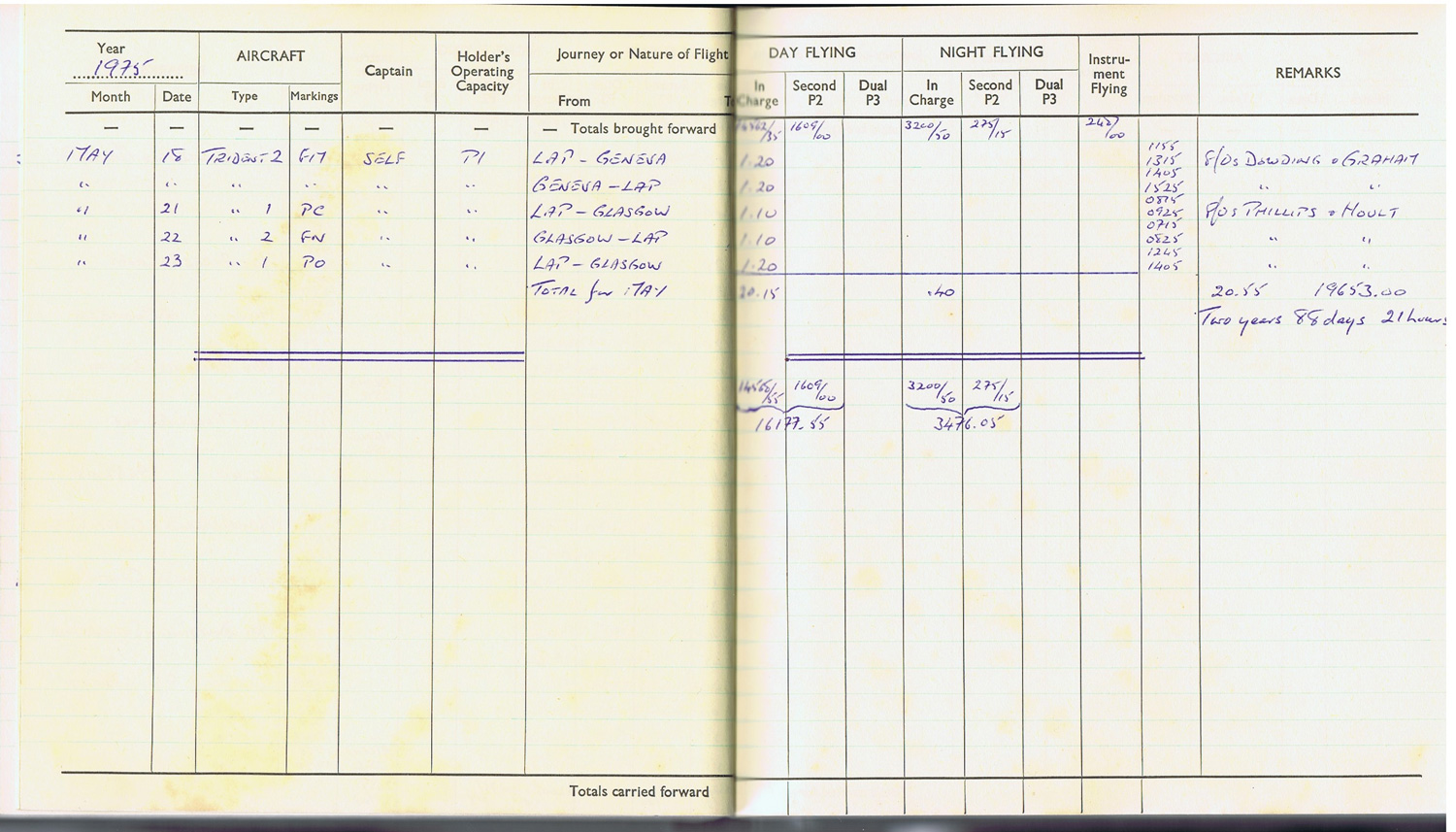
Noel’s last flight and the last page from his last logbook
He had started his career in a single engine Tiger Moth in 1941 and ended up flying the Trident 2, a modern jet with automatic landing capabilities. Events and luck had allowed him to fulfil his childhood ambition.
As he said, more than once, “I was luckier than most”.
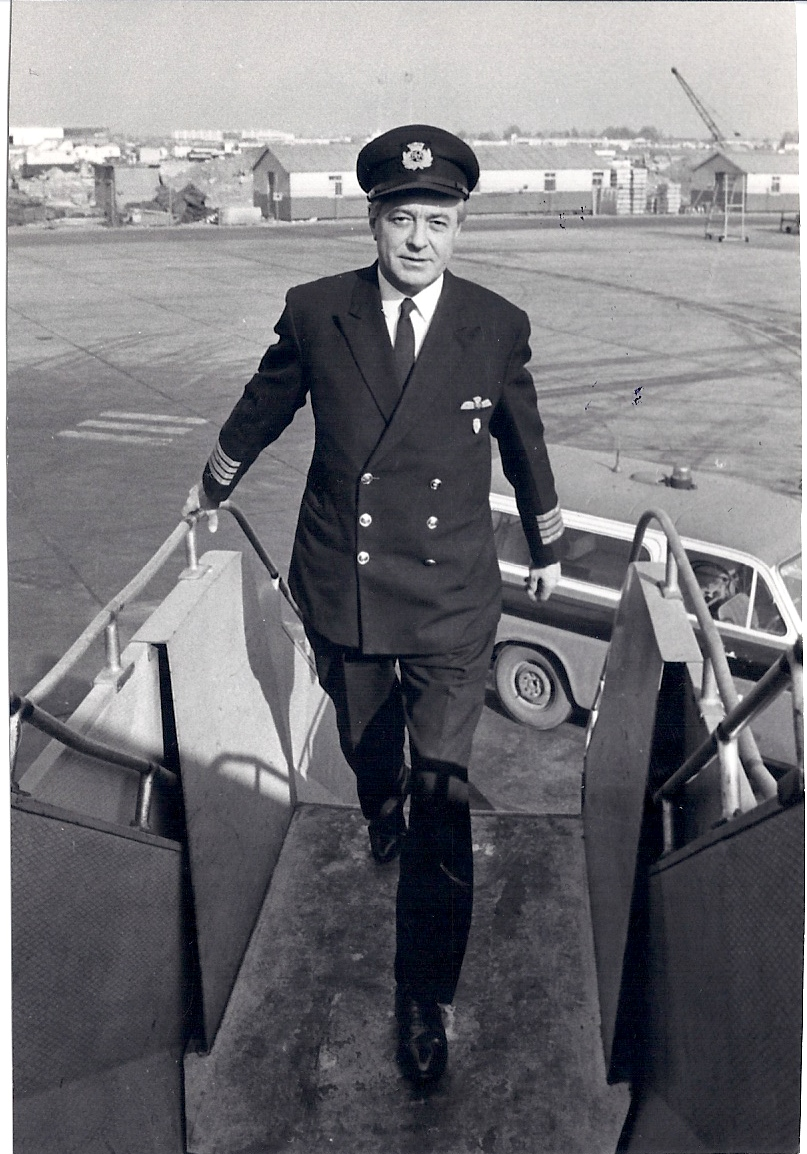
Noel Barker BEA
References:
1: Some Recollections of 153 Squadron in Northern Ireland and North Africa 1941-3 by Squadron Leader J.A. Haddon DFC.
2: 153 Squadron Monthly Records, dated 14th July and 26th November 1943 from Maison Blanche now held in the National Archives, www.nationalarchives.gov.uk.
3: Lost Voices of the Royal Air Force by Max Arthur. A Hodder paperback book.
4: A Dutch publication covering Operation Blackmail entitled Heksentoeren vanaf Gilze-Rijen, from Bulletin 412. No: 2, 2022, https://studiegroepluchtoorlog.nl
5: https://en.wikipedia.org/wiki/Kenneth_Rayment
6: http://www.cieldegloire.fr/002_raf_haddon_j_a_m.php
Relevant notes:
An interesting fact is that Noel Barker’s flying career spanned the whole of the existence of BEA from the split from BOAC in 1946 to the incorporation into British Airways in 1974.
Jack Haddon, Jonny Bentley, Ken Rayment all served in 153 and 264 squadrons.
Jack Haddon, Jonny Bentley, Ken Rayment, Tony Holderness all remained life-long friends.
Ken Rayment and Tony Holderness became pilots at BEA and were godfathers to his first two children.
Jack Haddon was staying with Noel Barker when he died on 7th May 1993. They went for a pub lunch at the Merrie Harriers in Cowbeech. Noel was at the bar buying a drink for his old friend when he had a heart attack and died. No doubt, they would have laughed about that!
Peter Barker
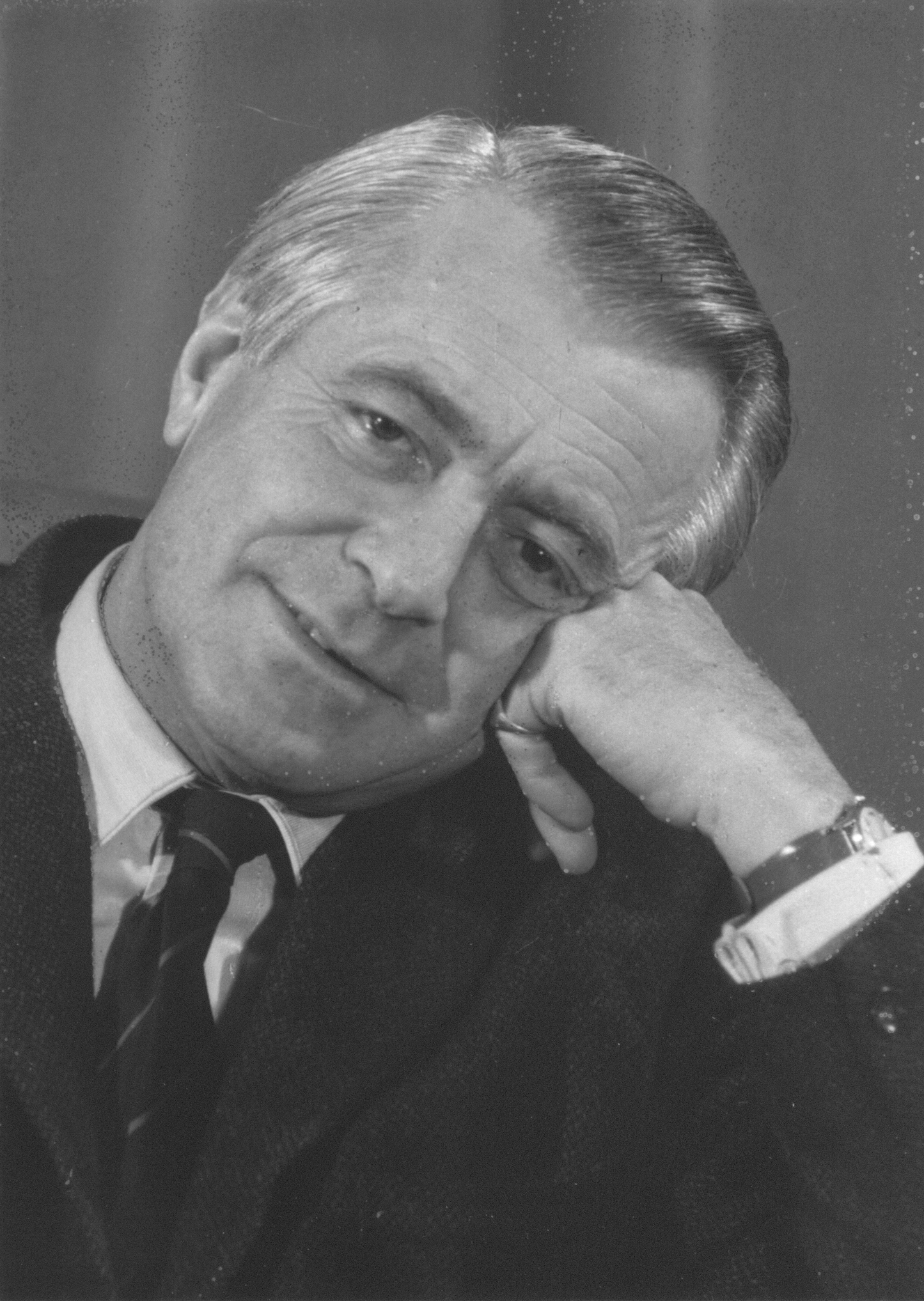
Noel Barker
Editor’s note – all images are © Peter Barker / Barker Family

