


Customised jets glinting in the sunshine, precision formation aerobatics and regular attendance at top aviation events - you might well be thinking of the Red Arrows, Frecce Tricolori or Patrouille de France, but the Breitling Jet Team has the same hallmarks as those famous military aerobatic teams.
Currently displaying seven Aero L-39C Albatros, the Dijon, France, based outfit is the world's largest civilian jet aerobatic team. "Today I think we're well positioned, nearly equal to the national jet teams," the team's leader Jacques Bothelin told Global Aviation Resource. As a civilian operation promoting a commercial business they of course differ from the military jet teams which are about recruitment and projecting national prestige. But in operating comparable aircraft and performing a sophisticated routine mixing formation, synchronised, opposition and solo flying, the Breitling Jets are certainly in the ballpark of their military peers.


That's perhaps not surprising when you consider who's involved. Jacques himself has been displaying for 30 years, and has given over 2,600 displays in 28 countries, making him one of the world's most experienced display pilots. He is accompanied by ex-French Air Force pilots Bernard Charbonnel, Christophe Deketeleare, Francois Ponsot, Frédéric Schwebel, Philippe Laloix and Patrick Marchand. They are all experienced former Mirage F1 and 2000, Alpha Jet and Jaguar pilots, with most also having previous display experience. Laloix was in the Patrouille de France in 1993-1997, Ponsot was the French Air Force Mirage 2000 display pilot in 1997 while Schwebel and Marchand both flew with the fondly-remembered 'Raffin Mike' Jaguar E duo. Collectively, they have nearly 50,000 flying hours. Experienced? You bet.
Emulating the military teams is a conscious decision. "For me - and it's not because you're English - the Red Arrows are the number one," comments Jacques. "I consider them the most professional jet team in the world. Unfortunately, we don't have the same performance with the aircraft and the general organisation and support they have, but for me they're a great example to follow.
"We consider our job as an entertainment more than a technical demonstration. We try to create positive emotion for the spectators. For that the precision of the formation and the aerobatics are important, but we also use the quality of the smoke systems, the flares, the music, the commentary, the elegance of the manoeuvres. We consider our display as an artistic act, and we try to create a full emotional environment."


It's an approach that clearly works - each summer the team does 20-30 displays all across Europe, this year taking in venues in France, Switzerland, Austria, Spain and the UK (at the Royal International Air Tattoo, which Breitling sponsors). The team also regularly displays beyond Europe, with many performances completed in the Middle East and a trip to the Cape Verde Islands in 2009.
This success continues a long tradition. Jacques established Apache Aviation, the company running the team, in 1980, naming it after his dog. Apache subsequently ran a number of very successful, high-profile aerobatic teams using SIAI Marchetti SF260s and then Pilatus PC-7s - Patrouille Martini, Patrouille Ecco and Patrouille Adecco. After a few years flying a pair of unsponsored PC-7s as 'Les Apaches', Jacques decided to move onto jets and with sponsorship from Khalifa a four-ship team of L-39 Albatros jets was launched in 2002. The aircraft, low-houred former Soviet Air Force examples, were overhauled by an Estonian company (and registered in Estonia) involving the fitment of new GPS equipment and a moving map display.
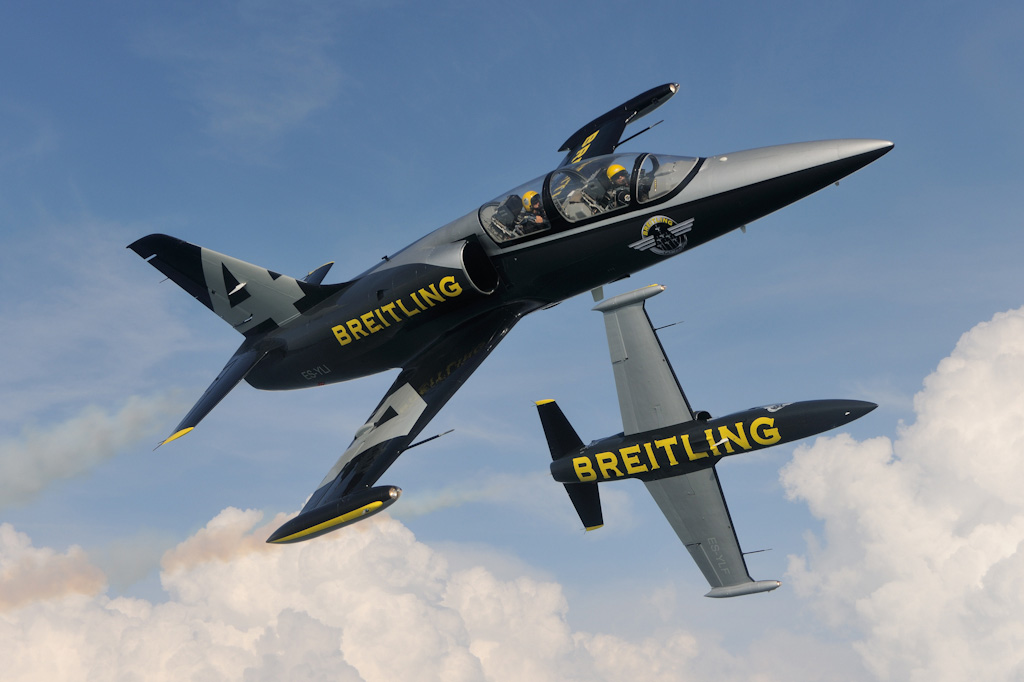
Breitling subsequently became sponsor, with the Breitling Jet Team being launched in time for the start of the 2003 airshow season. Further investment by the chronographer in subsequent years has enabled the team to expand to five aircraft (2004), then six (2005) and latterly seven (2008). In 2010 they got a swish new paint scheme mixing black and grey with distinctive yellow Breitling titling.


The team is part of Breitling's diverse sponsorship portfolio which also includes the AeroSuperBatics Wingwalkers and the Super Constellation at Basle Airport. The team is now fully integrated in Breitling's marketing activity, with many of the team's formation shapes named after Breitling products. Last summer Christophe Dekelateare flew to Spain to shoot a video with Nigel Lamb in his Breitling MXS called 'Racing for Anna' that now features on the Breitling website. Breitling has recently issued a limited edition Breitling Jet Team chronograph. And later this year the team is due to tour the eastern Mediterranean taking in Greece, Turkey, Jordan, Lebanon and Israel. In 2012 they're hopeful of attending the Al Ain Aerobatic Show, a venue they've displayed at several times, as part of a planned Gulf tour.
For Breitling, a Jet Team makes sense. The stylishly-marked L-39s with big bold numbers on the tailfins and wings, and Jacques and his wingmen striding around purposefully in matching black flying suits, gives the team - and therefore Breitling - an allure. Like any premium goods manufacturer Breitling sells luxury and aspiration, and to the public fast jets and jet pilots have a glamorous, stylish cachet. Cool sells.


Not that it's just Breitling taking from the partnership. "You have to know that the financial support of Breitling represents about 85 to 90 per cent of the cost of our operations," Jacques revealed. "The remaining amount is what we get from airshow organisers, mainly fuel and accommodation and sometimes some money depending on what we do for them. We need the good relationship with Breitling, because otherwise we just could not do our operation."
The L-39 uses 700 litres per hour and each aircraft needs 400 litres for a display. Multiply that by seven at today's high fuel prices and you can clearly see the challenges involved with running an operation of this nature. This has a bearing on the way the team operates during the winter months. Although there is a pre-season training schedule, unlike the military teams the Breitling Jets do not practice day-in, day-out.
"As team leader and manager of the company my main concern is that the team is ready in time for the beginning of the airshow season, but not too early," Jacques says. "If we're ready now we've still got one month until the start of the airshow season which means we have to have additional training sorties to keep current. For us, each sortie is an investment, especially with the rocketing prices of fuel. We enjoy flying, but we do not fly for fun. With the kind of weather we have today [7 April] here in Dijon I'd be so happy to tell my technicians to bring an aircraft out of the hangar and go and fly some aerobatics. But I just can't afford that."

A stark insight into the costs involved with a major jet operation - and bear in mind the L-39 is comparatively economical. However, training costs are lowered to an extent because there isn't a turnover of pilots each year. "For us, as long as the guys are feeling good they stay in the team so we don't need a lot of training at the beginning of the season," Jacques explains. "We've never had a guy departing the team so we've really built the confidence and experience, and I think that's very important for safety and quality which are the two key words in our business."
Why does the team operate the L-39? The key factors are simplicity, reliability and documentation. "It's quite an easy aircraft to operate," Jacques says. "For example when we went to Al Ain last year we travelled 210 flying hours [30 hours for each jet] with absolutely no snags. I don't know any military jets at the moment which have the same record. We're able to travel without a support aircraft and no spare parts, although we FedEx some parts from here in Dijon if required. Its reliability is a real quality."
Documentation is crucial in operating civilian jets. "It's important to have the right paperwork to fly," Jacques stresses. "We're purely in the civilian environment and we fly internationally so we need aircraft that have the right paperwork, Permits to Fly and Certificates of Airworthiness because we just wouldn't be able to operate otherwise.


"I have a dream to operate the F-5, which is quite affordable on the market, but the maintenance and fuel are not affordable and I don't see how we could get the correct paperwork to operate that type of aircraft. So paperwork is very important. For me the L-39 is the best compromise on what I know about the jets available on the market."
All these factors explain the L-39's popularity as a jet warbird for the moneyed private pilot in Europe and the USA over the last 15 years. With so many L-39s around the spares market is plentiful, but Jacques points out "you pay for what you get". He says: "It's possible to buy engines for 40,000 euros but most of them are corroded and not in good condition". To get around this the Breitling Jets' engines are now overhauled by LOM in Prague. "We have to pay 150,000 euros for an overhaul but I think we're on the safe side doing that because of our commitment to safety," comments Jacques.


Despite all these advantages Jacques says the L-39 isn't flawless. "We cannot climb to very high altitudes, especially with the drop tanks, and our typical cruising altitude is between 20 and 25,000 feet. We cannot fly above the weather when we are in formation so sometimes it's not as comfortable as military jets flying over the weather systems. The controls are not assisted, and so it's quite heavy so you have to pump some weight at the gym if you want to be efficient with the L-39!"
This is an issue in formation aerobatics because, as Jacques explains, it means "the guys on the outer edges of the formation are at the real edge of the performance in the L-39". This certainly makes the Breitling Jets' pilots' formation changes and second-half manoeuvres - like the 'Apache Roll', where one L-39 corkscrews around the others - all the more impressive.
For this reason Jacques is cautious about expanding the team further even though he actually has a further three L-39s at his disposal, two of which are Breitling branded. It's already a complex job with seven L-39s, and adding more would complicate it. "If we put more aircraft in the team I don't want to break the dynamism of the show because the formation will be too 'heavy' to move," Jacques says. "If we try and fly with more aircraft, will we really be able to stay as we are? Even now engine management is quite tricky. Adding one more aircraft to a formation makes it ten or twenty per cent more difficult than it was.


With his extensive experience and knowledge it's unsurprising Jacques has some strong views about airshows and their future. "It's very interesting to think about the entertainment business developing in different types of activities," he says. "Can you imagine the same type of pop concert today that you had 20 or 30 years ago? Opposite to that, take a picture of the ramp at any big airshow. You can take one 20 years ago and it's nearly the same.
"Things have not changed a lot and not changed enough. We had a very big change with the Red Bull Air Race - that was a way to offer a different type of entertainment and show through the competition in those races, plus the side acts. It was a different approach. A lot of people were not happy with that, but [Red Bull] were bringing a lot of media and attention to aviation and they were thinking differently."
Jacques says the airshow world has got to buck itself up. "Consider the attraction we have - so many spectators, but so few sponsorships. That means we don't sell ourselves properly. Any entertainment business with this number of fans should also be an advertising platform. And with that money, we could develop things."


Nor, he says, should that change be limited to events. "To go to greater professionalism we need more teams like ours," Jacques says. "If you want to entertain spectators properly and create a wow factor, you cannot just fly for yourself and for fun. You really have to develop an act which is not just for your own pleasure." It's certainly a logical argument: create full-time, professional, dedicated flying entertainment teams whose pilots work the media which, in turn, enhances events' commercial appeal.
Jacques recalls the time after the Adecco sponsorship finished to illustrate his point. "I spent three years trying to find a new sponsor and it took me that time to realise that I needed to change my product. I flew nine years with Martini and eight years with Ecco/Adecco and at the end of that I just wanted to keep the same aircraft and the same show. It took me three years to realise that I had to change and evolve and when I decided to stop with the PC-7s and move onto the L-39s, I found sponsors again. During those years I desperately tried to find a sponsor for the PC-7s, there was nothing because it was not something new."


Jacques therefore feels continual evolution is essential for airshows in every area. "We need new things, we need creativity, we need innovation, which I think is something very important for the public," he says. For the Jet Team, this means continually developing its performance. Last year the backing music was changed as well as the introduction of the new paint scheme. "It's the thing about innovating," Jacques says. "We have to bring something new every year. We pop flares on the final split now and we wanted to use those flares in colours this year. Unfortunately we've not yet succeeded in sourcing the proper pyros, but that's the target we have - always to bring something new and something different."
For more information about the Breitling Jet Team, including the 2011 schedule, please visit www.breitling-jet-team.com.

If you would like to discuss using any of our imagery or feature content please contact us.