

Many a young child has the dream of growing up and becoming a pilot, having been enthralled by the marvel of flight from a young age. Experience proves there is a long road to achieving that goal, but First Lieutenant Bill Strohecker is proof that dream does come true, indeed his American dream goes further, by representing his United States Air Force overseas on the soil of its ‘special friend’ in international relations.
Bill is very much a new kid on the block at the 493rd Fighter Squadron, part of the 48th Fighter Wing at RAF Lakenheath. Having arrived in the UK in November 2009, his hours on the F-15C Eagle are barely over one hundred, leading him to label himself amusingly as ‘very green’ in terms of his experience to date. The hours are a mere statistic though; he is a mission ready and capable fighter pilot or ‘deployable’, as he likes to put it. It’s been a long road, a three and a half year journey after graduating college which is where Bill takes up the story.


“After graduating college I received a commission through our OTC and then I immediately went to a pilot training base located in Witchita Falls, Texas, known as Sheppard Air Force Base. I started my pilot training there and completed it in June of 2008. Following completion of that class I went to San Antonio, Texas - to Randolph Air Force Base - and attended what’s called IFF (Introduction to Fighter Fundamentals) where you move from basic pilot skills which I learned in pilot training to actual tactical basics, how to fly as a formation and basic fighter concepts, visual fighter concepts, manoeuvring an aircraft in relation to another aircraft in a tactical setting, so against a non-co-operative aircraft.
”So, that training lasted another four months. During that time the Air Force will send aircrew such as myself through water survival training, land survival training, resistance training and various other schools and academics. I guess you could say that prepares us for once we hit the ground here at a unit. I am a mission ready pilot, so taking it back again, after I finished IFF in San Antonio, I then went to my first F-15 unit which was located in Clement Falls, Oregon. It’s an Air National Guard unit out there and that’s where I learned how to fly the F-15. That was six to nine months where I was certified in flying the F-15 and then flew here. I did a quick ten to twelve flight spin up and now I’m a mission ready F-15C pilot.”


So what about the challenges of coming to the UK, not only in terms of flying operations, but also the honour of representing the United States overseas?
“You first get here and you just do a local orientation sortie, learn how to fly in UK airspace, where things are located, various airfields, where not to fly - all slightly different than in the US – and how to talk to air traffic control here properly. Then we move onto basic fighter manoeuvres, essentially dog fighting, visual set ups, do several of those, you’ll move from an offensive type of fighting to a defensive type of fighting to a purely neutral type of fighting, and you’ll move onto more complicated three and four aircraft missions, again remaining within the visual arena. And then you’ll step it out even further, the progression is from two aircraft to four aircraft, to eight aircraft, close in to further out, so eventually you’ll get to where two versus four, two versus six, to eventually four versus four, four versus eight, four versus X. And that’s the typical sorties we’ll fly around here. Start long range and move it into something closer so you practice all your skills in a sortie.”
Hand in hand with the demands of flying a high performance fighter in a different country to your own, comes a certain social responsibility.


“I take it as a sense of responsibility too. Since there are so few of us and we do have that special relationship between your country and mine, I take it as a responsibility to handle myself in a certain way so I represent the United States properly in a way I would want someone else to represent us if I was back home. And I think it speaks for the strong relationship the UK and United States has that you guys, you allow us to operate here. It means a lot, living in Europe is a once in a lifetime opportunity I know I will always cherish.”
The days are long and intense for a fighter pilot of this calibre. A typical week for a pilot with the 493rd will involve three or four missions, hours of detailed pre-flight and post-flight de-briefing and time in the simulator. Luckily today Bill isn’t flying, hence he’s able to generously spare his time for myself, but if he were flying and launching at say 10:00am he would be on base by 6.30am and into briefing an hour later. De-briefing on recovery can last up to six or seven hours, meaning the day can be 12 hours long; gruelling considering the stresses on the body of an F-15C pilot. Bill modestly describes that as a ‘workout’, but I’m left imagining it’s much more that that!
The mission of the 493rd can be described as ‘to provide air superiority on a moment’s notice anywhere within European theatre.’ Bill expands upon this to describe what it means for him.


“We are always ready to deploy at a moment’s notice should the phone call come, it’s about being the first one into an air space and the last one out. It’s kind of sobering when you think about it - what it could actually mean to an individual like myself - but I take it seriously, it means a lot; something that I’m proud of, despite the fact we might not be involved in the conflicts going on right now in Iraq and Afghanistan. We definitely had a role in the opening hours, opening weeks, so that the missions we have on the ground right now and in the airspace can take place as they do at this moment.”
The F-15C is now over 30 years into its USAF service life and as a recently trained Eagle pilot, does Bill feel it still packs the punch in terms of its rivals in today’s fighter market? Bill’s recent trip to Frisian Flag, a NATO equivalent of the American ‘Red Flag’ exercise, was an eye opener for him in terms of that capability.
“Frisian Flag is a European, large force exercise where we had aircraft from Sweden, Finland, Poland, Germany, the Dutch and our own. We had naval participation, plus surface to air simulations, as in SAM sites. It was a good NATO exercise I guess is the way you could describe it and that was my first experience.


”It is still, despite its age, the big kid on the block I guess you could say. That’s just the role that we play in a large force exercise. If we’re escorting a strike package, we’re still the first ones in, and we have to establish that air superiority before anything else can follow behind us. And we’re always the last ones out providing tail cover. So that says a lot about the capabilities, and to some extent almost the dependency of a successful mission; that is what rests on the shoulders of the F-15C community.
”I never actually found myself in a visual situation with any of the other aircraft I was engaging, it was always beyond visual range, so I didn’t really get to appreciate or get a better understanding for the full capabilities of the other aircraft I was up against. But we did have a, I guess you could call it a show and tell day, on the ground where we got to go and climb all over the other countries’ aircraft, get to see what they look like, sit inside, ask questions of the other pilots just as they got to do the same with ours.
”It is still an extremely capable aircraft despite the fact that yes it is a 25 to 30 year old airframe, depending on when the jet was built that I might be flying that day; older than me in any case! But that exercise was an eye opening experience; I’ve always been told it is still a great aircraft but just to see it in its full capacity up against our NATO partners…! The mission we hold is still crucial to making sure a successful large force deployment would actually work should it happen in wartime. So I was impressed. I was more than impressed!”


I take a moment to contrast the mission of the sister squadrons within the 48th FW at Lakenheath in terms of their ability to practice their mission. As the F-15E can practice dropping ordnance if required, is their a disadvantage in not being able to pull the trigger for real?
“We can go out and simulate pulling the trigger but that’s just it, it’s a simulation. So we’re dependant on computer models to assume that had this taken place it would have worked out this way. Just like a black box recorder airliner, we track our flight path through the sky, so we’ll come back after a sortie, and yes, you were in a bad position here, you were too fast there, you should have done this with your air speed, you should have pointed your aircraft that way. So we actually can replicate fairly well, despite the fact we’re not actually dropping anything off of our aircraft on a day to day basis. The simulator is great way to keep your skills sharp when, for example, anything from bad weather to maintenance issues can keep you on the ground so you might not be able to fly that day or maybe two to three days in a row.“
The transformation from civilian to fighter pilot is a steep learning curve for sure, but Bill is very much grounded in terms of considering where he started and where he is now.


“The transformation from civilian to whatever you want to call me now??? When you sit down and think about it is kind of surprising; it’s been a long road. I still talk to my buddies back in college who really don’t look at me any differently. It’s kind of crazy to think about what we do on a day to day basis, but you can’t really explain to your wife when you come home at the end of the day because it will just bore her to tears.
”But we get so excited about it; we could talk about it for hours! We just wish that we could explain it in a way that other people would get excited about it too and understand what it’s like, and really we talk about it as being fun or as being a rush, we don’t really talk about the responsibility that it truly entails. Simply from the aspect of every time we go fly our government is handing us the keys to a 40/60/80 million dollar asset, whatever number you happen to read that day. Strictly from that aspect, like I was saying, if the phonecall should come - what we’re expected to do, what we train to do every day, yeah it’s sobering, to use that word again. It’s quite a change from where I was studying in college!”
Not that there is much time to consider the past, with a busy schedule ahead for the rest of this year for the 493rd.


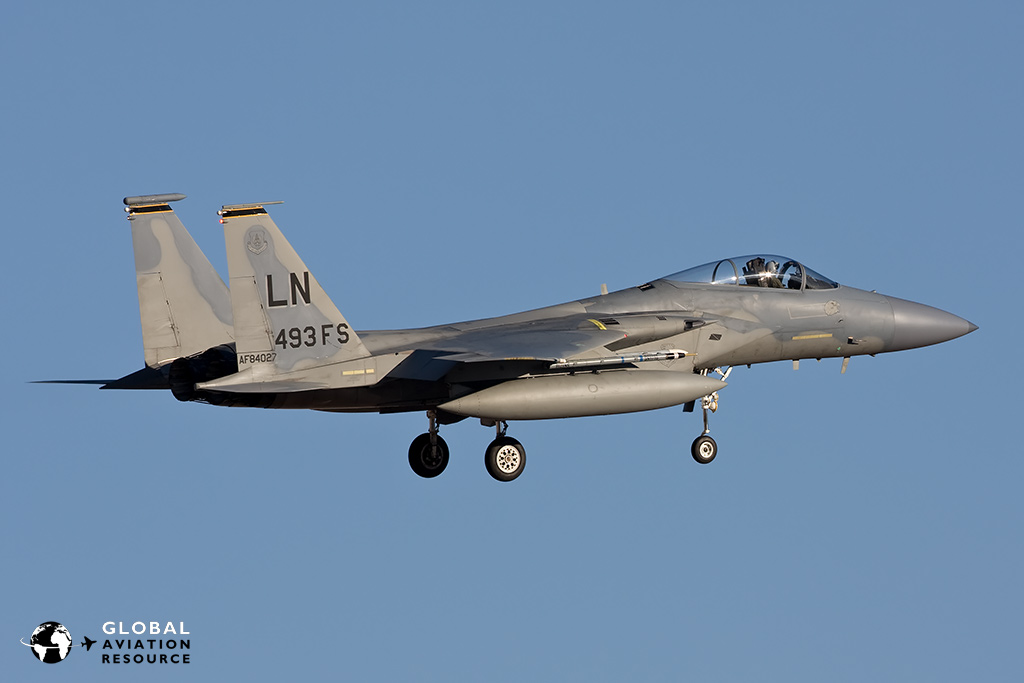

“We’re doing operations in Bulgaria in the next three weeks. We’re also going to Turkey for an exercise similar to the one in the Netherlands. We have NATO air policing missions in Iceland and Lithuania at the end of the year which is part of our mission; we’re rotating in and out with other host countries.”
Certainly not a sign that the F-15C is ready to grow old gracefully just yet and, judging by the development work going on at the base during GAR’s tour, RAF Lakenheath and the 48th Fighter Wing will be gracing our skies for a good while yet.
GAR wants to interact with its readers so if you have a question for the author or a comment to make on this feature, please click on the button below. The best comments will appear right here on GAR.If you would like to discuss using any of our imagery or feature content please contact us.