

It’s too noisy to interview Flt Lt Leon Creese outside. With the funfair at Waddington International Airshow almost adjacent to the 45(R) Sqn King Air on static display we’ve taken refuge inside the aircraft so I can successfully record the interview. The problem now is that it is roasting in here, like a greenhouse, so we’ve positioned ourselves near the open door at the rear of the aircraft to try and get some air. Consequently, with yours-truly and photographer Paul Filmer inside the compact cabin Leon can only find one place to sit – on the King Air’s toilet.
“This is a first” he says laughing!
Unlike many of the solo display pilots for the RAF, Leon finds himself on the airshow circuit for a second consecutive season. He wasn’t expecting to find himself back displaying the aircraft this year but when the planned replacement pilot pulled out for personal reasons Leon was back in the hot-seat.
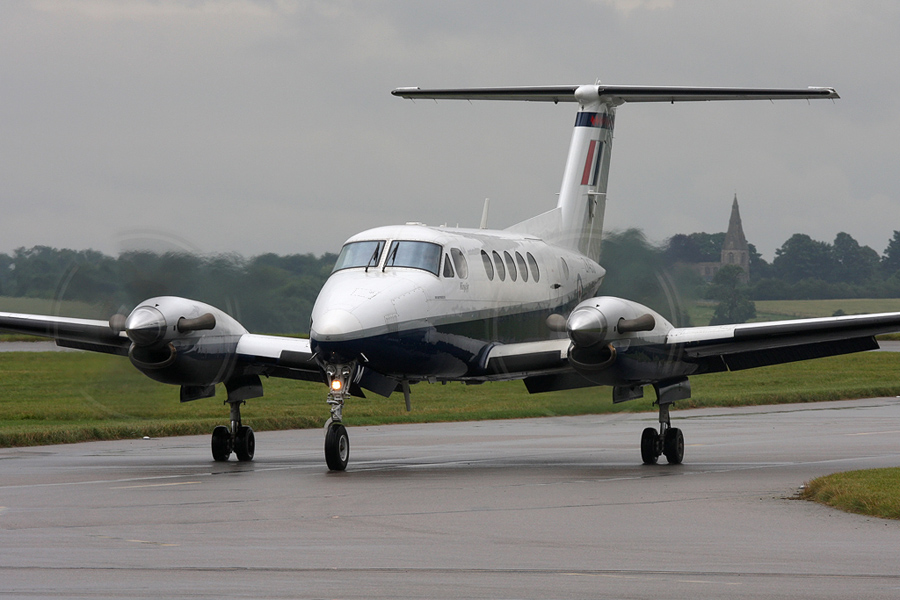

“There simply wasn’t anyone else suitably qualified, or as enthusiastic, who could take over, so it ended up being me” he explains.
“If I was a pilot in the BBMF or the Red Arrows I would have been carrying on anyway so who knows, I might even be back next year, we’ll see.”
Leon was on ‘QFI Course Number 1’ for the King Air and when he first flew the aircraft it quickly became apparent that it would lend itself to display flying.
“It’s a powerful and surprisingly agile aeroplane and was a new asset for the RAF; for those reasons I strongly felt that we should be displaying the King Air and showing it off.”
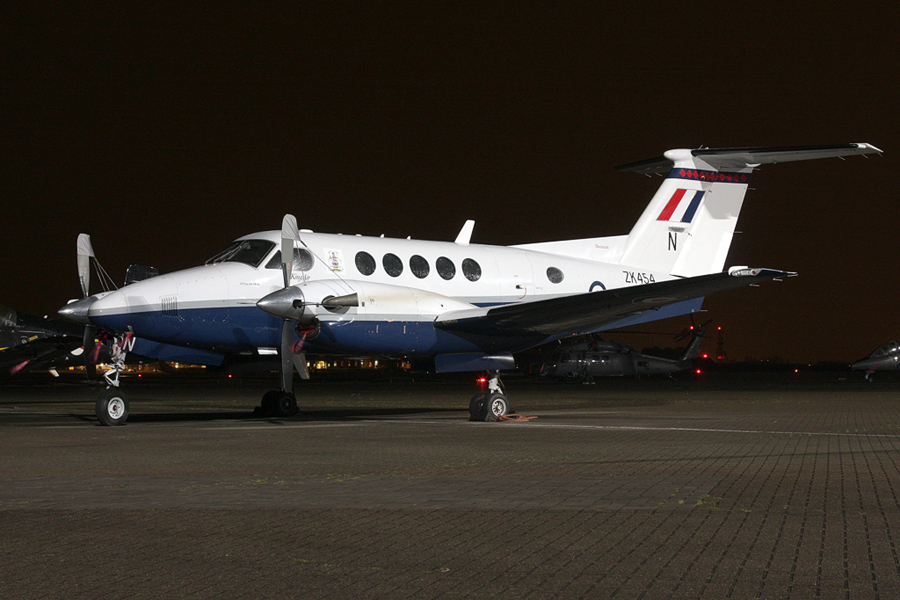
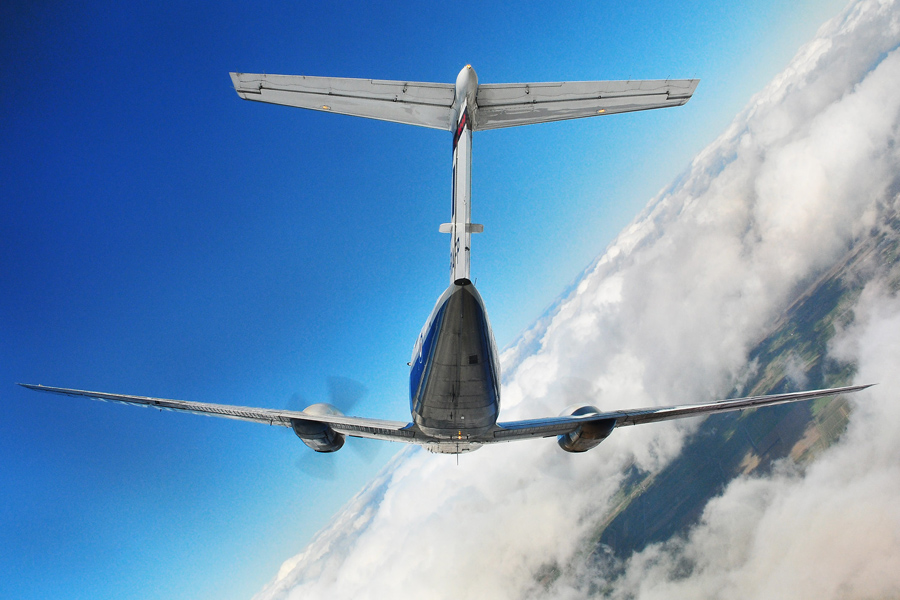
Some four years later, Leon finally got the go-ahead: “With the support of the Station Commander at RAF Cranwell, OC operations Wing and also our Squadron Commander we were able to put a proposal in place to do exactly that. I was definitely helped by the fact that Station Commander, Group Captain Nigel Warmby, is a former Harrier display pilot and I really consider him to have been my mentor through the whole process.”
Leon was teaching instructors at this point and it was while instructing Gp Capt Warmby on the aircraft that he got the opportunity to sell him the idea for a King Air display.
With the backing he needed in place Leon was left with just one hurdle; not only had the King Air not been displayed for the RAF before, but, to the best of anyone’s knowledge, it had actually never been displayed anywhere before. Where do you start, I wonder?
“We looked at the dimensions, the turn radius, available ‘G’, available speeds and so on. I was able to work out how things would fit together by doing the calculations and plotting the complete sequence out.
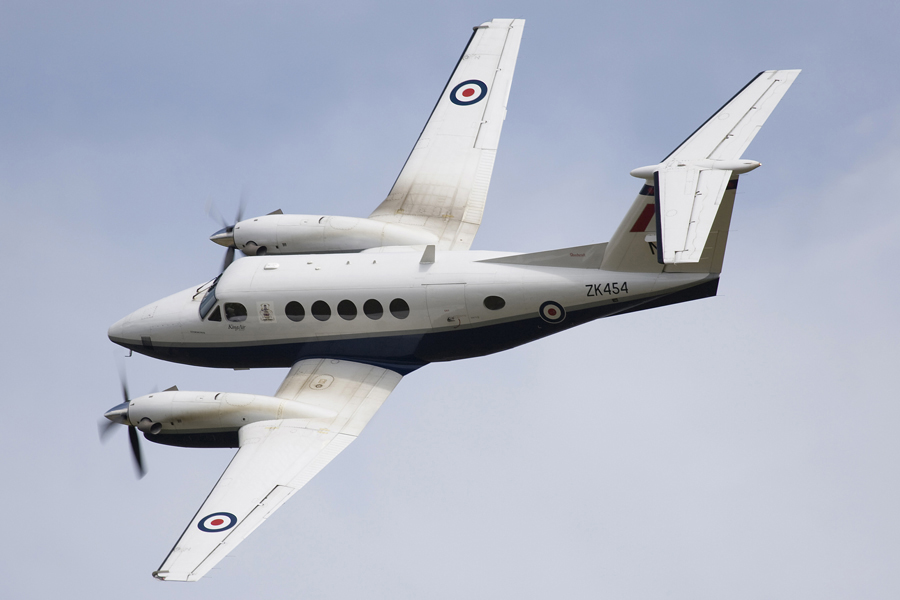
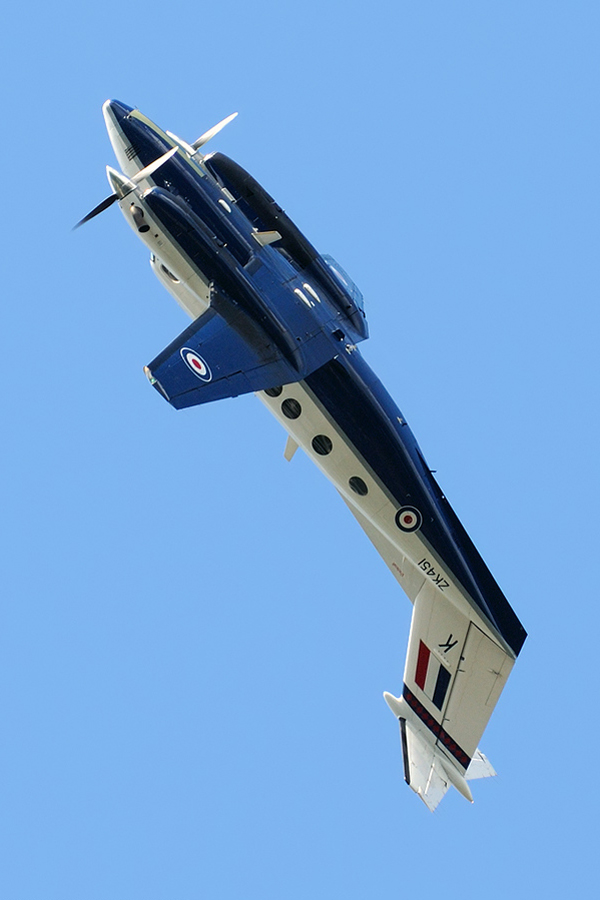
“I went up with Gp Capt Warmby and we started out in what we call upper-air, above 5000 ft. Well away from the ground in other words!”
“We tried the sequence of manoeuvres, all of which were within the realms of what we do with the aircraft on normal operations. We had never tried this before obviously and while some of them worked, some didn’t work so well. It was very much a paper planning exercise in order to turn it into a full sequence.
“The aircraft is certified to +3.17 and -1.27G but the problem is that the King Air has no g-meter or fatigue meter!
“Therefore the way in which I had to design the display was very mathematical. I had to consider all the bank angles versus G for level balanced turns, sixty degrees of bank, seventy degrees of bank and so on. What I tend to do is fly to around 2G by design which gives us 1.17G to play with so that if I do need to make a slight adjustment or if we take a bump from a gust of wind we’ve got safety margins in place.”


This is one of the most fascinating things about Leon’s King Air display. It was a massively analytical process to plan the display and remains so in terms of flying it. I’m actually not sure I’ve come across a more analytical approach to display flying before. His sequence has been calculated so exactly and so mathematically, mainly because it had to be but partly so that Leon could fly the smoothest, most precise and compact display possible.
And what about the wonderful final manoeuvre, a regular on the display circuit when we used to see C130 demos; the famous Khe Sahn approach? It is probably no co-incidence that Leon himself has flown two tours on the Hercules, including operations in Kuwait, the Balkans and Sierra Leone.
“If we were ever operating this aircraft in a threatening environment it would be something we could do; the squadron doesn’t routinely train for it but we could if required.
“In terms of technical difficulty it is certainly the hardest part of the display. The stopping point is the tricky bit as I’m trying to stop just beyond datum (crowd centre) so that I can reverse back to datum and that is where the display finishes. The whole approach is flown at idle power and we tip in from 1000 ft, knowing that even with the heaviest aircraft that as long as I commence the recovery at the right height we’ll be fine, so safety is not an issue.”


OK, so it looks dynamic, it is, and it looks scary, but it isn’t; the finesse is the hard part.
“The whole thing is based on where to tip in, that’s everything. Once we’ve done that we’re committed; we’re on our way down! We can always add power if necessary but I don’t like to do that as it detracts from the whole point of it being a steep tactical approach.”
So, having worked on the sequence Leon sought approval from 22 (Training) Group to bring his practices down to a lower altitude and, with approval granted, carried on working up for the beginning of the 2008 season.
Leon was able to utilise the King Air simulator at Cranwell in order to assist with his work-up, though he admits that it doesn’t handle ‘exactly’ like the real thing, despite being broadly similar. What it did do was help him plan for flying the sequence at his actual display height and he could see how the routine would work over an airfield venue. The simulator was also used to practise and rehearse for emergencies in a display scenario with everything from loss of crew communications to loss of an engine, or even the “hugely unlikely” loss of both engines planned for.


An extremely successful debut season saw Leon and co-pilot Flt Lt Duncan Wright win the Wright Jubilee Trophy for the best display by a RAF training aircraft and then go on to thrill crowds at events across the country, joined by second co-pilot Flt Lt Ben Mason. Leon’s delighted to be back for another go this year, despite final decisions on the display being made quite late in the day.
“We were held up a little by administrational issues which needed resolving. Once we’d been given the go-ahead we were ready to practice and then start working back down to low altitude.”
“The main thing in terms of working-up this season was that I have a new co-pilot, Flt Lt Chris “Kiwi” Enright. It wasn't too long before I regained the feel for what my hands and feet need to be doing during the display but I need a lot of information from him while I’m flying it; he needs to know all the heights, all the speeds and all the limitations.”
It sounds to me a little bit like a rally driver’s ‘mate’ – a fair analogy?


“It is very much like that although I don’t need him to tell me when to turn left or right!” says Leon.
“I spend a lot of the time looking out of the cockpit and the view is actually fairly poor. We have no upper windows so when we’re in a steep turn I can’t actually see much at all and I’m often reliant on Kiwi to let me know when we’re approaching or passing the datum and to make other similar calls so I know exactly where we are.
Additionally there is one interesting fact which maybe some people aren’t aware of regarding the King Air. While most aircraft being used for displays are designed so that their throttles may be slammed open to full power, that’s not the case with this aircraft.
“If we slam the throttles forward to max power we’ll over stress the propeller gearboxes and break the aircraft in an instant. Everything is done from the gauges and as the torque increases when we increase speed we have to monitor that very closely, especially at high-power settings. I’ll look after the bulk of the power settings but it is Chris’s responsibility to fine-tune them.”


It sounds like a busy cockpit during the display to me........
“It is very busy and we’re talking almost the entire time as well. I’ll be asking Kiwi things or he’ll be telling me things, calling out heights and speeds, speed over the top, how much I need to pull and so on. I could do it on my own looking in to the cockpit but then I wouldn’t be able to look out so well to find the datum, or see aeroplanes or birds that may come wandering in to our airspace, or of course the ground.”
Ah yes, the ground, always worth looking out for that one!
The King Air is the only RAF solo which routinely displays to a piece of music and, in ELO’s ‘Mr Blue Sky’ Leon seems to have found an almost perfect fit for the routine. I can’t resist asking how that one came about.

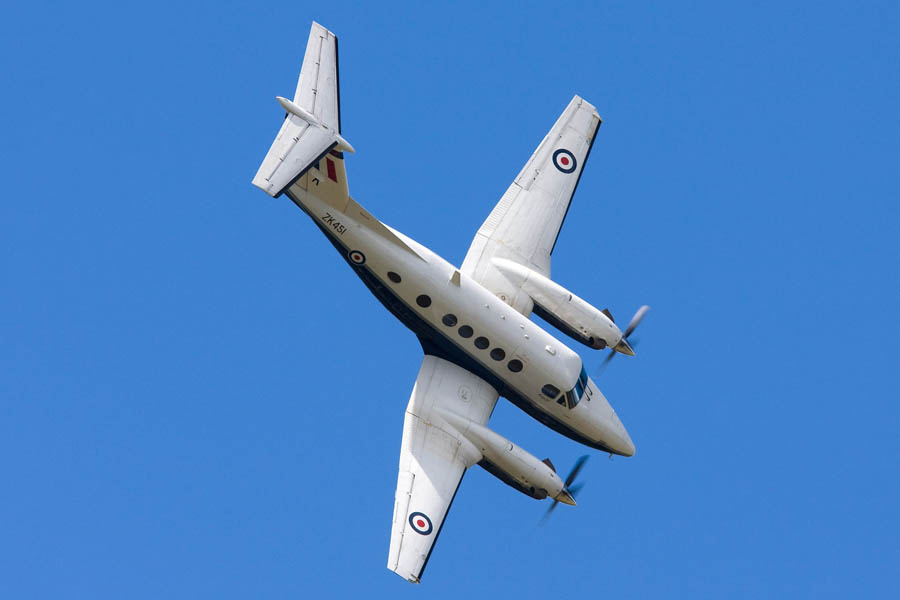
“It was my wish to have music available for the commentators to use, especially those who perhaps don’t know too much about the King Air or the RAF, which you can find at some of the smaller events. The music enables the commentators to talk when they do have something interesting to say and when they don’t then the music can take centre stage.
“I’d seen some other displays set to music and feel that it can work very well. I have however also seem some displays when it can have the opposite effect. Rather than leave it to the commentators to decide I thought I would choose the music and they can use it as they see fit.
“I actually used FSX (Microsoft Flight Simulator 10) and the default King Air model which is close enough in the way it flies, and flew my display. I then viewed the display from the exterior, the tower view in the simulation, and then overlaid the music from my computer.
“To find the right one, I played dozens of tracks until I was happy with the tempo; I wanted something upbeat and cheery but it clearly couldn’t have any political connotations! Mr Blue Sky seemed to fit the bill and, having used it a few times last season I have now asked for it at all the shows this year. It’s been very popular with the crowds.”


In line with all the RAF display pilots Leon must use his time on the ground to engage with the public as much as he can and also consider the impact his time away has on his Squadron.
“I think it’s fair to say that it was a fine line whether we could have a King Air display or not” he explains. “To mitigate the impact of our display programme, most of the transit sorties to and from the shows are flown as instructional exercises. We have to consider the impact when I’m away at the weekend and also the impact the workload can have on me when I return to work after displaying. If I’m away for a two day show like this one then the weekend is full-on and I want to do as much as I can on the ground with the aircraft as well as flying in the show.
“I can’t fly for more than six days straight so that means I get a day off in the week to cut the grass and clean the car and all those sorts of things, but that is a day away from the Squadron.”
Unlike Typhoon for example, Leon also points out that he has no travelling army of support when he comes away, nor indeed back home at Cranwell.


“It’s just me and Chris really although sometimes we might pull a student in to help with some of the admin, but it is essentially a two man band. Each show probably generates about ten documents and I’m flying displays at thirty nine venues this year which gives you an idea of the admin involved. What mustn’t happen is for that to get in the way of my role as a King Air instructor and I do try and instruct every day that I’m there. It’s expected that I will do that.”
There are currently nine King Airs with 45(R) Sqn and two of those aircraft are GT models which Leon doesn’t display, mainly because he hasn’t yet completed the conversion course. That of course leaves seven aircraft, five of which are military registered and it is from those five that Leon rotates the aircraft he displays.
Leon’s King Air display has clearly been a breath of fresh air as far as RAF participation and airshows in general are concerned. To see what is essentially a small airliner displayed in such a fashion was always going to grab people’s attention but is also an exercise in crew co-operation and planning of the highest order. Coupled with the way in which Leon and his colleagues have embraced the airshow scene and are spreading the word about their work at Cranwell and the world of multi-engine flying in the RAF, they deserve all the plaudits they get.


Finally, the next time you are fortunate enough to see Leon display the King Air just stop and think for a moment just how much has gone in to making this sequence the highlight it has become. He has, almost single-handedly, written the display handbook for the King Air and the fruits of his labour will be passed on to the next pilot who displays the aircraft for the RAF. Assuming he or she can shift Leon that is.

If you would like to discuss using any of our imagery or feature content please contact us.