

It's Sunday morning in Southport and day two of the annual airshow. Saturday's show attracted in the region of 35,000 spectators, a large crowd whichever way you look at it and one which would impress even the most experienced of display pilots, let alone one making his debut; which is exactly what Lt Ian Sloan did the previous day.
A little more than two days ago Ian was awarded his DA (display authorisation) for the Sea Hawk and then, there's nothing like a baptism of fire, headed up to Liverpool Airport for the North West's biggest airshow and his first public display in an aircraft of great historical significance.
"It's great really, it's nice to have the aircraft flying and it's been a long year for the Royal Navy Historical Flight (RNHF) in general" he says.
"It would have been great to have all the aircraft available in this special Fly Navy 100 year; last season the Sea Hawk was a real stalwart and we also had the Swordfish serviceable but it's taken until now to get the Sea Hawk up and running again."
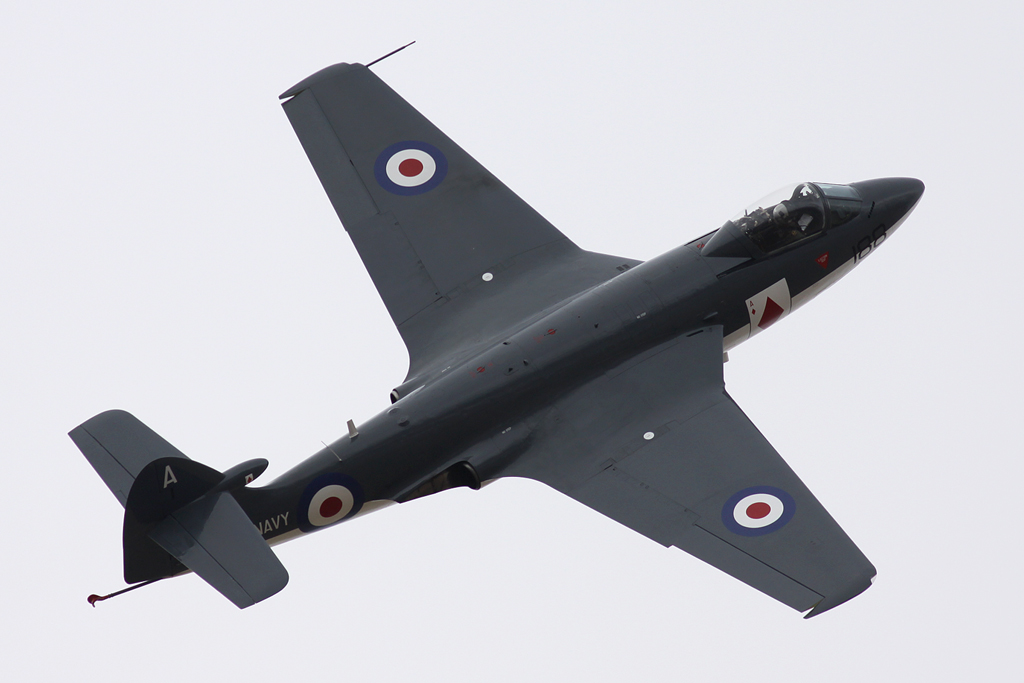

Ian joined the RNHF at the beginning of this season but, with the Sea Hawk out of action, quite simply didn't have anything to fly.
"It was really a case of when the aircraft was available I could get some time in it.
"I needed to get five hours in the aircraft before being able to display so it was a quick 'conversion to type' with Lt Cdr Chris Gotke, having spent a lot of time with previous Sea Hawk display pilot Lt Cdr Matt Whitfield. Chris supervised my first flight and on my second flight we did some formation work and photography and I then moved on to working on my display."
The build up to display flying is not a process which can be rushed and Ian admits that it was one which he "eased" himself in to; we are talking about the world's only airworthy Sea Hawk after all, and one assumes that flying it must come with a huge weight of responsibility?


"There is careful mentoring but then you have to basically go and take some responsibility and fly it, but, at the back of your mind you do think about how careful you have to be!
"When I read the background to the aircraft it is an incredible story. If you build a Sea Fury with a jet engine the Sea Hawk is what you get. It's a classic Hawker design and you can see the lines of the Sea Fury in this aircraft, they just moved the tail wheel to the nose, moved the cockpit to the front so you can see where you're going and put a jet engine in the middle."
That the Sea Hawk has classic lines is undeniable, as is its significance to the history of the Royal Navy and the Fleet Air Arm. Originally designed by the Hawker Aircraft Company, the Sea Hawk F.1 first entered front-line service with 806 Squadron in 1953. When Hawker Hunter orders for the Royal Air Force were given the highest priority, responsibility for constructing the Sea Hawk F.2 passed to the Armstrong-Whitworth Aircraft Company who produced them under licence. The fighter bomber variant, the FB.3, first flew in March 1954 and became the most widely used version, seeing service with no less than eleven Naval Air Squadrons, serving both ashore and on-board carriers. While the FGA.4 was intended as the definitive ground support version, the variant suffered from poor engine performance and in 1954 Rolls-Royce introduced the more powerful Nene 103 with about 50 FB.3s being refitted with these engines to become FB.5s and FGA.4s receiving the same modification to become FGA.6s.


Sea Hawk equipped squadrons, flying from the aircraft carriers HMS Albion, Bulwark and Eagle were called to give support to the Anglo-French operations over Suez in November 1956. In the absence of Royal Air Force close air support the Royal Navy provided all of the British ground attack effort, and the Sea Hawks attacked Egyptian targets, often in the face of a barrage of heavy ground fire. After Suez, the Sea Hawk's days were numbered and their phasing out from operational service began in 1958, with their replacement being the Supermarine Scimitar. By 1960 the Sea Hawk was operating only in second-line duties with training squadrons and the civilian-run Fleet Requirements Unit, although the aircraft also saw export success serving with the Marineflieger in West Germany, Dutch and Indian Navies, while the latter only replaced their aircraft as late as 1983.
The Royal Navy Historic Flight's Sea Hawk, WV908, was built at Baginton, Coventry, in late 1954 as an FGA.4 variant and assembled at the company's Bitteswell airfield before being delivered to the Royal Navy in February 1955. She served initially with 807 Squadron and then 898 Squadron embarked on HMS Ark Royal and HMS Bulwark and also ashore at the Royal Naval Air Station Brawdy.


After conversion to FGA.6 standard at the Royal Naval Aircraft Yard Fleetlands she flew with 806 Squadron until 1960 when she was relegated to second-line duties with 738 Squadron at the then Royal Naval Air Station Lossiemouth. In June 1962 the aircraft was sent for storage at the Royal Naval Aircraft Yard Belfast before being loaned to the RAF Apprentices' School at RAF Halton in March 1971 for use as a systems trainer. She was then acquired by Royal Naval Air Station Culdrose in Cornwall and restored to flying display condition in 1977-78 before finally transferring to RNAS Yeovilton to join the RNHF in 1982.
After a further period of storage she flew briefly in 1989 before being taken to British Aerospace's Dunsfold works for a complete refurbishment which was completed in 1996. She is now resplendent in the livery she wore when servicing with 806 Squadron, at the end of her front-line career aboard HMS Albion.
"There are some things with the way the jet works which we have to be very aware of and the fuel system in particular is most definitely 'early jet technology'. It's not like a more modern jet where you can slam the throttles open and it will look after itself; in the Sea Hawk there is a real danger that doing so would damage the aircraft" says Ian.


"It's like any old aeroplane, you have to be gentle with it and coax her around to ensure we preserve it for as long as possible. Let's be honest, people don't want to see the Sea Hawk pulling 9G like a Typhoon, they just want to see it. It's comparatively slow for a jet and very graceful and that is reflected in the way we display it."
Ian himself is an immensely experienced pilot, currently on the staff with the Naval Flying Standards Flight (fixed wing) operating the Hawk and, as a Sea Harrier and then Harrier pilot, has flown on operations worldwide, including over Afghanistan in support of Op HERRICK. The fact that the Sea Hawk carried out very similar missions in the Suez crisis 50 years earlier than recent Harrier Operations is not lost on Ian. Flying the Sea Hawk though is something entirely new.
"It's a huge crossover really" Ian admits.


"The cockpit is a whole mish-mash with instruments everywhere and the handling is very different from the other jets I've flown. The aircraft has very precise ailerons which are very effective, especially initially after take-off where you might sometimes notice a little roll. But flying a slow-roll, the stick will be hard-over and that's all you get, the aircraft doesn't roll rapidly.
"The Sea Hawk is also very heavy in pitch and quite often I find myself with two hands on the stick hauling her around the sky, a little bizarre for such a small aeroplane!"
So, how did it feel the previous day I wonder? Sitting in the aircraft at Liverpool John Lennon Airport, with a two day old DA and about to demonstrate the aircraft for the first time in front of tens of thousands of spectators?
"I was sitting in the cockpit with a few nerves jangling away but once I took five minutes to compose myself and go through exactly what I was going to do it was fine, just like any other sortie. I went through the checklist very carefully to ensure that I wasn't about to drop a clanger from the word-go! "


Ian must have enjoyed himself as GAR was at Liverpool Airport to see his return from displaying at Southport and the aileron rolls prior to his break for landing bore the trademark of pilot who was certainly very happy with life at that moment.
"That was a bit of showmanship I guess but yes, it does feel great to be doing this. To get a couple of shows under my belt will certainly help things next year, especially as it didn't look like I'd get to convert on to the jet, let alone display it in 2009."
We couldn't let Ian go without a quick word about an event that was due to happen later that day in Southport, a series of flypasts with the Kennet Seafire which would be in the capable hands of the legendary John Beattie. A treat not just for the assembled masses but one assumed for Ian too?


"The Seafire is a beautiful aeroplane. That strikes me every time I see it and I feel the same way about the Sea Fury. Just the fact that we are able to fly these aircraft together is amazing and John Beattie has been a great help with my preparation for displaying the Sea Hawk. We have flown many times together in the Jet Provost as part of my work-up and having him on hand for advice is invaluable. John has probably forgotten more than most people know about displaying historic aircraft so flying with him today will be a great experience."
It's been a tough year for the RNHF and there really is no way of finessing that fact that in this hugely significant year commemorating the centenary of naval airpower that they have been incredibly unlucky to see their fleet of aircraft hit with long-term serviceability problems. The flight deserves great credit for working so hard to get the Sea Hawk back to the airshow circuit before the year was out, and she will hopefully take her in place in the final Fly Navy 100 flypast scheduled for Liverpool on the 23rd of October; this despite the fact that she has yet to return home from the Southport Airshow! A technical problem occurred prior to Ian's departure and he was forced to travel back to RNAS Yeovilton by road but, all being well, the Sea Hawk should be ready to join the massed ranks of helicopters and aircraft that will complete the celebrations.
The Sea Hawk is a unique aircraft and one of great significance, not just to the Royal Navy but to British aviation history itself. In Ian Sloan the RNHF has a pilot who bridges the gap between past and present perfectly; a current fast jet instructor working with serving naval pilots and one who respects and admires those who have served before him and the aircraft they flew. We look forward to seeing both the Sea Hawk and Ian a little more often next season.



If you would like to discuss using any of our imagery or feature content please contact us.