


The mission of the United States Coast Guard (USCG) is to protect the public, the environment, and US economic and security interests in any maritime region. Tracing its history back to 1790, when Alexander Hamilton founded the Revenue Cutter Service, the Coast Guard lays claim to being the oldest sea going service in the US. Today, the US Coast Guard is a branch of the US armed forces which reports to the US Department of Homeland Security during peacetime, with the ability to be transferred to the Department of the Navy by the President or Congress during time of war.
In order to accomplish its mission, the USCG has a network of installations throughout the coastal regions of the US, including the Great Lakes, using a mixture of vessels and aircraft. The Coast Guard operates both fixed wing aircraft and helicopters in the maritime patrol and rescue role. The two main types of helicopters operated are the Eurocopter HH-65 Dolphin and the Sikorsky HH-60 Jayhawk.


USCG assets in the US are organised into districts, with California being the responsibility of the 11th District. This district is of vital importance to the US economy with several major ports falling within its area of operations, including Los Angeles, Long Beach, San Francisco and San Diego. In order to fully protect them, there are several Coast Guard Stations located along the California coastline, in close proximity to these vital ports.
One such station is Coast Guard Air Station (CGAS) San Diego, adjacent to the city’s international airport, Lindbergh Field. The base has its own hangar complex and operations ramp and is equipped with three Sikorsky HH-60J Jayhawk helicopters. This helicopter is a derivative of Sikorsky’s ubiquitous H-60/S-70, sharing a close relationship to the US Navy’s variant, the SH-60 Seahawk. Development of the Jayhawk began in 1986, in response to a requirement to replace the aging Sikorsky HH-3F Pelican then in USCG service. The resulting HH-60J was delivered in the early 1990s, and specialises in long range Search and Rescue (SAR).

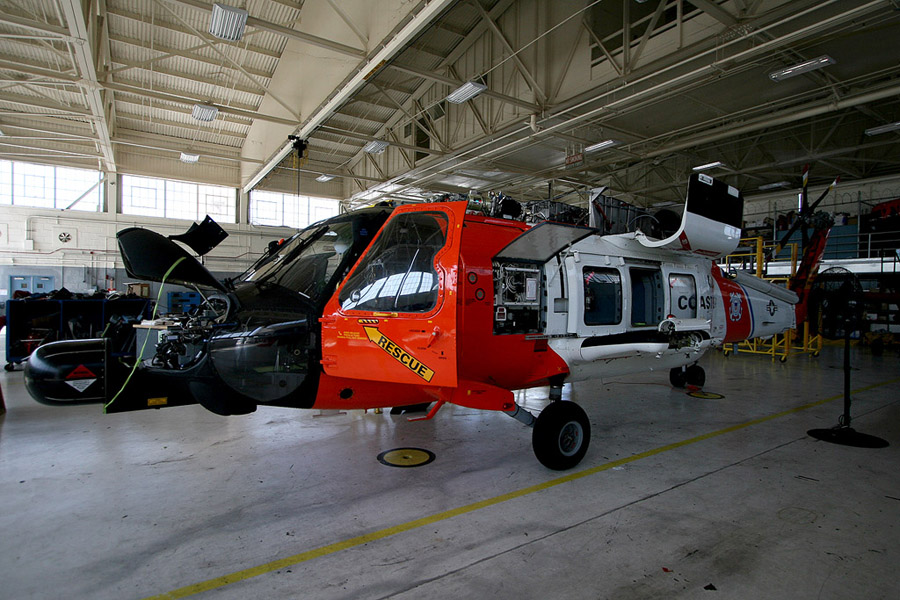
As part of its development into a Coast Guard helicopter, the HH-60J received a distinctive nose radome containing a search/weather radar and a powerful rescue hoist on right hand side of the cabin. The hoist can be equipped with a variety of attachments, depending on the rescue profile required. It is crewed by a team of four - two pilots, a flight mechanic and a Rescue Swimmer.
The Rescue Swimmer has perhaps the most dangerous job, as he or she may be called upon to enter the water in order to assist in recovery of a casualty. Coast Guard Rescue Swimmers are a small, elite group who undergo a gruelling 18 week course of training and physical conditioning before they can qualify. As many of the CG missions involve medical evacuation (medivac), they are also required to be trained as Emergency Medical Technicians, in order to provide care to a casualty, although for missions where more seriously ill people are to be picked up, a Flight Surgeon may join the crew.


The Jayhawk can be fitted with up to three external fuel tanks, which extend its endurance to approximately 6.5 hours. In terms of distance, this can equate to a 300 mile transit followed by a one hour SAR operation and a 300 mile return to base. Although it remains a useful and reliable helicopter, the Jayhawk is starting to get a little long in the tooth, and is currently the subject of an upgrade program which will result in the MH-60T. This so-called “Deepwater Program” will provide a glass cockpit and other avionics upgrades and also include an airborne “use of force” package, providing weapons for warning/disabling shots and crew armour.
To fulfil their SAR and emergency medivac roles, two of the helicopters at CGAS San Diego are kept ready to fly, with the third undergoing maintenance. A helicopter crew, plus engineering team stands ready to scramble should they be called into action. The alert crew are required to respond to a call and potentially be airborne within 30 mins, however in cases of dire emergency this can be reduced to around ten minutes if required.


Along with the emergency role, the USCG has a more regular role of patrolling the port and associated shipping channels, in keeping with its Department of Homeland Security (DHS) assignment. Due to its location close to the border with Mexico, CGAS San Diego also has a more unusual role for a USCG unit - that of border security, in conjunction with US Customs and Border Patrol, another branch of the DHS.
Through its many missions, the US Coast Guard provides a vital service to the American people, standing ready to assist 24 hours a day, seven days a week throughout the year. The men and women of CGAS San Diego are an integral part of the USCG plan in protecting the coastline of Southern California, and supporting the government's Homeland Security network.



If you would like to discuss using any of our imagery or feature content please contact us.